+91 95752 60218

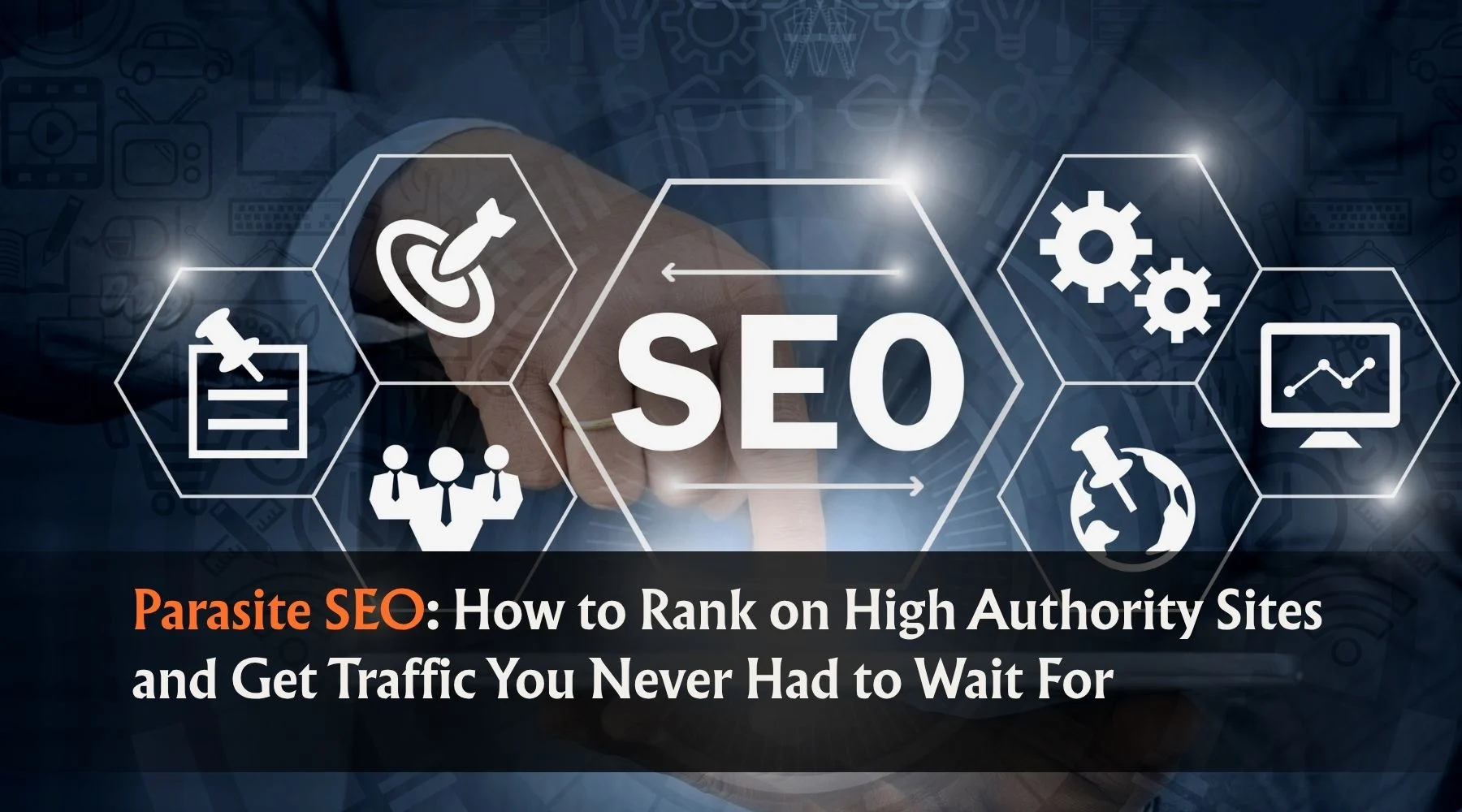
Your Website Is Brand New. Google Doesn’t Trust It Yet. Now What?
Here’s a situation that almost every business owner and marketer in India knows too well.
You’ve built a proper website. You’ve written useful content. You’ve done your keyword research, added the meta tags, cleaned up the site structure. And then you wait. And wait. And weeks turn into months with barely a trickle of organic traffic, because Google simply doesn’t know your domain well enough yet to send anyone your way.
This is the cold reality of SEO for new and low-authority domains — it takes time to build trust with search engines, and until you do, even excellent content can sit invisible on page four or five of the results.
This is exactly where Parasite SEO comes in. It’s not a shortcut in the sneaky sense of the word. It’s a legitimate, strategic approach that lets you borrow the authority of platforms that Google already trusts deeply — and rank for keywords your own domain couldn’t touch right now.
Let’s break down exactly what it is, how it works, which platforms to use, and how to do it without putting yourself at risk.
What Is Parasite SEO? (And Where Did the Name Come From?)
The term “parasite” sounds negative, but the concept itself is straightforward and widely used by professional marketers, established agencies, and solo entrepreneurs alike.
Parasite SEO is the practice of publishing content on high domain authority (DA) third-party platforms — Medium, LinkedIn, Quora, Reddit, Wikipedia, YouTube, GitHub, and others — optimised for specific keywords, with links back to your own website. The “parasite” refers to the content living on someone else’s domain and feeding off that domain’s existing authority to rank in Google search results.
Here’s why it works: Google ranks individual URLs, not entire websites uniformly. A well-written, properly optimised article published on Medium (Domain Rating: 93+) or LinkedIn (Domain Rating: 98+) will often outrank the same article published on a brand-new website — not because the content is better, but because the platform hosting it has years of accumulated authority, thousands of inbound links, and deep trust signals that Google has validated over time.
You’re essentially publishing on real estate that Google already considers prime property, rather than building your own property from scratch and waiting for it to appreciate.
Why Businesses — Especially New Ones — Use Parasite SEO
For small businesses, startups, and local service providers in cities like Indore, Bhopal, Pune, and Ahmedabad — where the competition for digital visibility is growing fast — Parasite SEO solves a specific and frustrating problem: how do you generate traffic and leads from search while your own domain is still building authority?
The answer is that you don’t have to choose between waiting for your own domain to grow and getting traffic now. You can do both simultaneously.
While your core SEO strategy builds long-term domain authority through content creation, technical SEO, and link building, Parasite SEO lets you rank for high-intent keywords on established platforms — driving referral traffic, generating leads, and building brand visibility right now.
For competitive keywords — “digital marketing agency in Indore,” “SEO services for restaurants,” “best CA firm in Bhopal” — ranking your own website quickly is nearly impossible without significant existing authority. But a well-optimised LinkedIn article or a detailed Quora answer targeting the same intent can rank within days, not months.
This dual-track approach is increasingly how smart businesses compete in India’s rapidly crowding digital landscape.
White Hat vs Black Hat Parasite SEO — Know the Line
Before diving into strategy, this is the most important thing to understand about Parasite SEO: there is a legitimate, Google-compliant version and a risky, rule-breaking version. The difference is not subtle.
White Hat Parasite SEO involves publishing genuinely valuable, original content on reputable platforms, earning natural placement on those platforms, and including contextual links back to your website where relevant. This approach follows the platform’s editorial guidelines, adds real value to readers, and builds authority legitimately. Google’s guidelines do not prohibit this — it’s essentially good content marketing on trusted platforms.
Examples of white hat Parasite SEO include: writing a well-researched article on Medium about a topic your target audience searches for; creating a LinkedIn article that answers a common question in your industry; contributing a detailed, genuinely helpful answer on Quora with a reference link to a relevant page on your site; publishing a comprehensive how-to guide on GitHub Pages or Notion for a technical audience.
Black Hat Parasite SEO involves mass-producing low-quality content stuffed with keywords across dozens of platforms simultaneously, using automated link schemes, buying bulk placements on expired high-DA sites, or publishing spam-level content purely for the link — not the reader. This approach violates Google’s spam policies and can result in penalties not just to the parasite page but, in some cases, to the linked domain as well.
The line is simple: if the content genuinely helps someone who reads it, it’s white hat. If it exists only to manipulate rankings, it’s not.
This guide focuses entirely on white hat Parasite SEO — the kind that builds sustainable traffic, earns trust, and generates real leads.
The Best Platforms for Parasite SEO in 2026
Not every high-DA platform works equally well for Parasite SEO. The best platforms are those where Google actively indexes and ranks individual pieces of content — not just the homepage — and where content from individual users can genuinely surface in search results for competitive queries.
Medium remains one of the strongest platforms for Parasite SEO. Domain Rating above 93, strong indexing, topic-based distribution, and a clean reading experience that Google favours. Medium articles regularly appear in top-3 positions for competitive informational queries. For businesses publishing thought leadership content, case studies, and in-depth guides, Medium is a first-choice platform.
LinkedIn Articles are indexed by Google and frequently appear in top search results for professional and B2B queries. LinkedIn’s domain authority is among the highest on the internet. For agencies, consultants, and service providers targeting business decision-makers — exactly the kind of people who search for “digital marketing agency Indore” or “SEO consultant for my startup” — LinkedIn articles are consistently effective.
Quora is particularly powerful for question-based and informational keywords. When someone types a question into Google, Quora answers frequently appear in positions 1–5. Publishing a detailed, well-structured answer on a heavily searched Quora question — with a reference link to a relevant page or article on your site — drives both direct referral traffic and contributes to your domain’s visibility. For businesses targeting audiences with questions in their niche, Quora is underutilised.
Reddit is increasingly indexed by Google, particularly after Google’s partnership update with Reddit content. Highly engaged subreddits with genuine communities can surface content in search results. This platform requires more nuance — Reddit communities are allergic to overt promotion — but businesses that participate authentically, answer questions, and add real value can earn significant organic visibility.
YouTube (owned by Google) ranks as one of the most powerful parasite platforms available. Video content hosted on YouTube ranks directly in Google search results — both in standard results and in the video carousel. For how-to queries, product comparisons, service explanations, and local business content, YouTube videos consistently outrank written content on new domains. If your audience watches video, YouTube Parasite SEO is arguably the single highest-ROI channel available.
Substack and Newsletter Platforms are growing in search indexing. Substack publications with consistent posting histories are beginning to appear in Google results for informational queries. For writers, consultants, and niche experts, building a Substack presence alongside Parasite SEO creates a compounding authority effect.
Press Release Distribution Sites like PR Newswire, Business Wire, and EIN Presswire carry extremely high domain authority and their content is indexed quickly. Press releases optimised for specific keywords can rank immediately for brand-related and news-adjacent queries, making them useful for product launches, service announcements, and event coverage.
Step-by-Step: How to Execute a Parasite SEO Campaign
Understanding the concept is one thing. Having a clear, actionable process is what separates the businesses that get results from those that publish a few posts and wonder why nothing happened.
Step 1: Keyword Research with Ranking Difficulty in Mind
Start with keyword research — but filter specifically for keywords where high-DA platforms already rank in the top 10 results. If you search a keyword on Google and see Medium articles, LinkedIn posts, Quora answers, or YouTube videos in the top 5, that keyword is a viable Parasite SEO target. Tools like Ahrefs, Semrush, and even the free Ubersuggest can help you identify keywords with high search volume and existing SERP presence from these platforms.
For local businesses in Indore, this means targeting queries like “best digital marketing agency in Indore,” “how to choose an SEO company in Madhya Pradesh,” or “SEO tips for small businesses in India.” Check the current SERP — if any of those results show a LinkedIn article, a Medium post, or a Quora thread, that’s your green light.
Step 2: Choose the Right Platform for the Right Query
Match the platform to the query intent. Informational queries (“how does parasite SEO work”) — Medium or LinkedIn. Question-format queries (“what is the best SEO tool for a small business”) — Quora. Service and product comparison queries (“digital marketing agency vs in-house team”) — YouTube or LinkedIn. News and announcement queries — press release distribution.
Step 3: Write Content That Actually Earns Its Place
This is non-negotiable. The content you publish on third-party platforms must be genuinely good. Not keyword-stuffed. Not thin. Not a barely-disguised ad. Write content that the platform’s audience would find valuable even if your website didn’t exist. Structure it clearly, answer the question or solve the problem completely, and include your link naturally — as a resource reference, not as the point of the entire article.
Long-form content consistently outperforms short posts on parasite platforms. A 1,200-word Medium article will typically outrank a 300-word post for the same keyword. Invest the effort.
Step 4: Optimise On-Page Elements
Even on third-party platforms, basic on-page SEO signals matter. Use your target keyword in the title. Use it naturally in the first paragraph and in one or two subheadings. Add a meta description where the platform allows. Use internal links to related content on the platform when possible. And include your link to your own website contextually — within the content body, where it naturally fits — rather than only in the author bio.
Step 5: Distribute and Amplify
Publishing the content is not the end of the strategy — it’s the beginning. Share the parasite content across your social media channels, link to it from your own website’s resources section, mention it in email newsletters, and engage with any comments or responses on the platform. The more interaction the content generates, the stronger its ranking signal becomes.
On platforms like Quora and Reddit, actively responding to follow-up comments builds your profile authority over time, which further amplifies the ranking power of your future contributions.
Step 6: Monitor, Measure, Iterate
Track the performance of each parasite piece using Google Search Console (for any traffic to your own site from those links), platform analytics, and rank tracking tools. Identify which platforms and keyword types are driving the most traffic and leads. Double down on what works. Retire what doesn’t. Parasite SEO is not a set-and-forget activity — it’s an ongoing content distribution strategy.
How Parasite SEO Feeds Your Lead Generation Funnel
This is where Parasite SEO transitions from a ranking tactic to a genuine business development tool — and it’s the part most SEO articles don’t cover.
When a potential customer searches for “how to improve local SEO for my restaurant in Indore” and lands on a detailed LinkedIn article you published, they are reading your expertise. They are forming an opinion about your knowledge and your agency. And if the article ends with a clear, natural call to action — “If you’d like a free audit of your current SEO setup, reach out to us here” — a meaningful percentage of those readers will click through.
This is exactly why the quality of parasite content matters so much for lead generation. A thin, keyword-stuffed article drives no leads even if it ranks. A genuinely helpful, expertly written article that solves a real problem for a potential client drives inquiries — not because it sells, but because it demonstrates capability.
For Digital Omnitech and similar agencies in Indore serving clients across Madhya Pradesh and beyond, Parasite SEO platforms provide visibility in front of exactly the right audience: business owners actively searching for SEO, digital marketing, and online growth solutions. The person typing “how does parasite SEO work” into Google isn’t a casual browser — they’re a business owner or marketer trying to figure out their strategy. Meeting them with clear, expert content on a platform they already trust is one of the most efficient lead generation moves available.
Common Mistakes That Kill Parasite SEO Results
Over-optimising anchor text. Using exact-match keyword anchor text in every link from your parasite content looks unnatural and can trigger spam signals. Vary your anchor text. Sometimes use your brand name, sometimes a natural phrase, sometimes just a URL.
Publishing on irrelevant platforms. A beautifully written article on a platform whose audience has nothing to do with your industry earns clicks from the wrong people and no leads. Platform relevance matters.
Treating it as a one-time activity. One Medium post will not transform your traffic. Parasite SEO is a sustained strategy — consistent publishing across the right platforms, over months, builds cumulative ranking power and brand visibility.
Ignoring platform community norms. Every platform has cultural expectations. On Reddit, selling is punished. On Quora, thin answers get collapsed. On Medium, low-effort content doesn’t get curated. Understanding each platform’s standards before you publish prevents wasted effort.
Forgetting the link back. It sounds obvious, but a surprising number of people publish well-optimised parasite content and forget to include a natural, relevant link to their own website. Every piece of parasite content should have at least one contextual link to a relevant page on your domain.
Parasite SEO + Your Own Domain: A Combined Strategy
Parasite SEO works best not as a replacement for building your own domain authority, but as a complement to it.
Think of it this way: your own website is long-term real estate — the value builds slowly but it belongs to you permanently. Parasite SEO is a high-traffic rental property — you get immediate visibility and income (in the form of traffic and leads), even while your own property is still being built and appreciated.
The businesses that win at SEO in competitive markets in 2026 are using both simultaneously. Their own domain builds authority month over month through strong content, technical SEO, and earned backlinks. Their Parasite SEO presence drives immediate visibility on high-intent queries where they can’t yet compete directly.
For businesses in Indore, Bhopal, and across Tier-2 India that are competing against larger, more established digital presences, this combined approach is not just smart — it’s often the fastest route to measurable online growth.
Related Blogs:
Importance of Internal Linking for Better SEO Results — The Complete Guide (2026)
Why SEO Is Still the Strongest Source of Long-Term Traffic
Frequently Asked Questions
Q1. Is Parasite SEO safe to use in 2026? Will Google penalise it?
White hat Parasite SEO — publishing original, valuable content on reputable platforms like Medium, LinkedIn, and Quora — is entirely safe and compliant with Google’s guidelines. Google penalises spam, manipulation, and link schemes, not genuine content on established platforms. As long as your parasite content adds real value to readers and links naturally to relevant resources, there is no penalty risk.
Q2. How quickly can Parasite SEO content rank on Google?
One of the biggest advantages of Parasite SEO is speed. Content published on very high-authority platforms can be indexed within hours and appear in Google search results within days — sometimes within 24 to 72 hours of publication. This is dramatically faster than ranking a page on a new or low-authority domain, which can take weeks or months even with good content.
Q3. Which Parasite SEO platform is best for local business lead generation in Indore?
For local business lead generation, LinkedIn articles and Medium posts tend to work best because they rank for professional and service-related queries and direct a high-intent audience. YouTube is also highly effective for local businesses that can create video content showing their work, testimonials, or expertise. Quora works well for businesses where the audience is actively asking questions about the services you provide.
Q4. How many parasite SEO pieces should I publish per month?
Consistency matters more than volume. Two to four high-quality pieces per month across two or three relevant platforms will outperform ten thin posts on ten different sites. Focus on quality, platform relevance, and genuine usefulness to readers. Build a publishing schedule you can sustain over six to twelve months for compounding results.
Q5. Can I use Parasite SEO for highly competitive keywords?
Yes — in fact, Parasite SEO is often the most realistic path to visibility for competitive keywords on a new or low-authority domain. If ranking your own site for “SEO agency in Indore” will take 12 to 18 months, a well-optimised LinkedIn article or Medium post targeting the same keyword can rank in weeks. This gives you a competitive presence while your own domain builds authority in the background.