+91 95752 60218

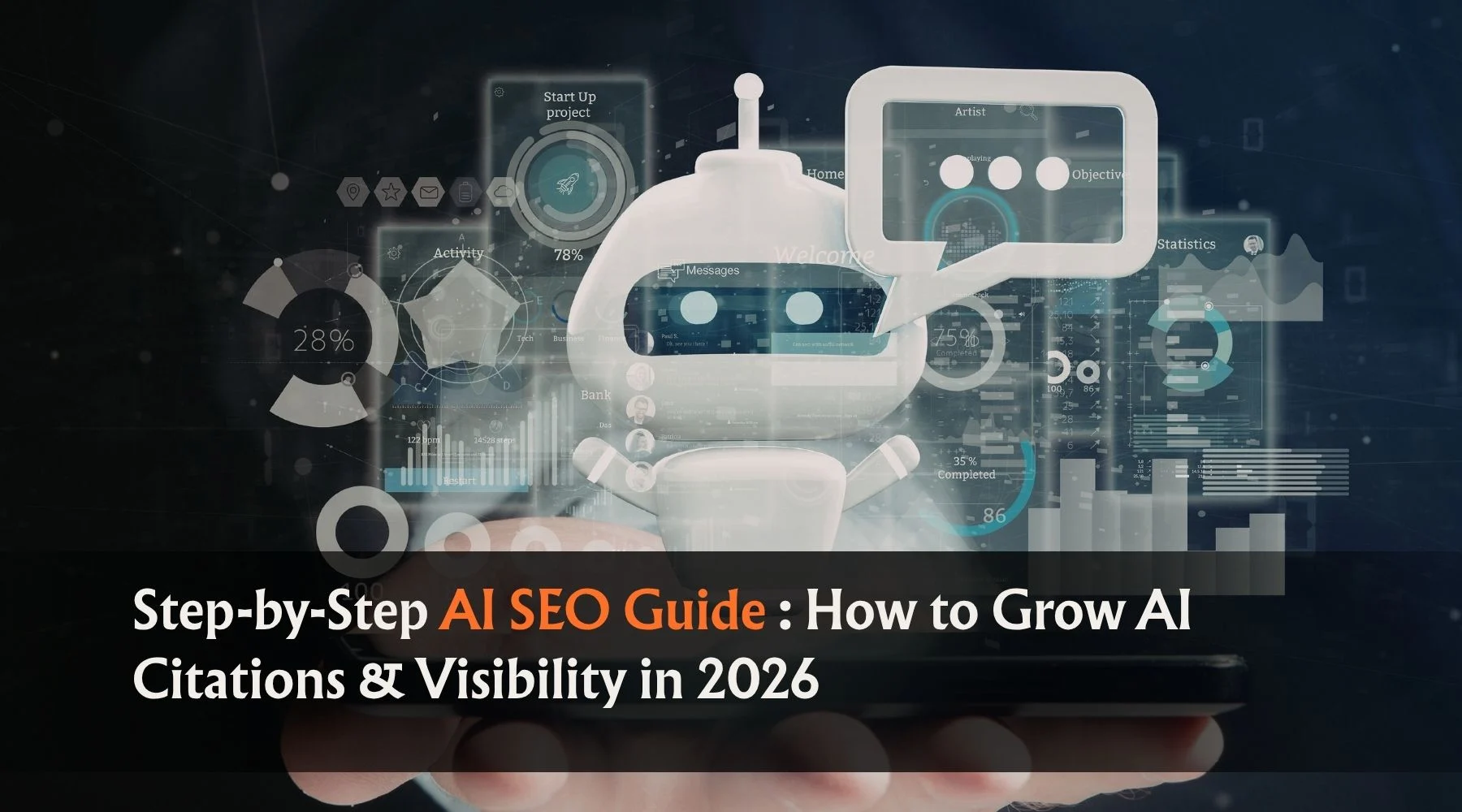
Search has changed — and if your business is still optimising only for blue links, you’re already falling behind. In 2026, a significant and growing portion of users go straight to ChatGPT, Perplexity, Google AI Overviews, or Gemini with their questions. They get an answer. They act on it. They never visit your website. AI-powered search handled over 527% more referral sessions in 2025 than the year before, and the brands showing up in those AI-generated answers aren’t always the ones sitting on page one of Google.
This guide walks you through exactly how to get your brand cited by AI engines — step by step.
What Is AI SEO and Why Does It Matter Now?
AI SEO is the process of optimising a website to improve its visibility by making its content accessible, understandable, and extractable for artificial intelligence systems. It is also known as Generative Engine Optimization (GEO), Answer Engine Optimization (AEO), or Large Language Model SEO (LLMO).
While marketers were perfecting their SEO game, the search landscape shifted. AI tools like ChatGPT, Perplexity, and Google’s AI Overviews are changing how search discovery works entirely. Ahrefs found that AI Overviews reduced click-through rates for top-ranking Google content by 58% — because users get their answer without leaving the page.
The good news: traditional SEO still matters. But it now needs to run in parallel with a strategy that specifically signals to LLMs that your content is worth citing.
At Digital OmniTech , we’ve been integrating these AI visibility layers into client SEO strategies because the window to move early is still open — but it won’t be for long.
GEO vs AEO vs LLMO — Understanding the Landscape
Before building your strategy, it helps to understand what each term actually means in practice.
GEO (Generative Engine Optimization) focuses on getting your content extracted and synthesised by generative AI tools like ChatGPT, Gemini, and Claude. AEO (Answer Engine Optimization) is about becoming the direct answer surfaced in platforms like Perplexity and Google AI Overviews, which always include citations. LLMO (Large Language Model Optimization) goes a layer deeper — it’s about influencing the retrieval sets and training data pipelines that models draw from.
Whether you call it AEO or GEO, the objective remains the same: to become the cited source or direct answer surfaced by AI models, ensuring maximum visibility in AI-driven search environments.
The most successful organisations are now developing parallel strategies that address both traditional search visibility and AI citation potential. Our on-page SEO and technical SEO services form the foundation for both.
Step 1: Audit Your Current AI Visibility
Start by knowing where you stand. Open ChatGPT, Perplexity, and Google AI Overviews and manually search your most important commercial queries — “best digital marketing agency in Indore,” “who provides SEO services for small businesses,” “top PPC management companies near me.” Document whether your brand appears, and where.
Then check GA4 for referral traffic from chatgpt.com, perplexity.ai, and similar AI platforms. This is your baseline. Everything you build from here should be measured against it on a monthly cadence.
Not all AI queries are equal in terms of business visibility. Some queries never require fresh retrieval, which means fewer citations. Focus on prompts that force tools to compare options and recommend brands. These are the queries worth targeting first.
Step 2: Build Answer-First Content Architecture
AI systems analyse web content differently from traditional search algorithms. Instead of focusing on keywords, they consider semantic meaning, factual density, source authority, and content structure.
The practical implication: every page that matters needs an Answer Block at the top — a direct, clear response to the core question within the first 100 words — followed by supporting evidence, context, and FAQs. Question-format H2 and H3 headings help LLMs map your content to user queries precisely.
For ChatGPT, structured formats like bullet points and FAQs are often lifted verbatim. Perplexity always includes citations, so prioritising authoritative sources and original data matters. Google AI Overviews respond well to FAQ/HowTo schema, short definitions, and visuals.
This is especially critical for local SEO — hyper-specific queries like “best digital marketing agency in Indore for small business” are now being answered directly inside AI interfaces, bypassing the SERP entirely.
Step 3: Implement Structured Data Aggressively
Schema markup is the clearest signal you can send to both search engines and LLMs about what your content means. Prioritise FAQPage, HowTo, Article, LocalBusiness, Service, and BreadcrumbList schemas across your site.
For product and e-commerce pages, Product and Review markup significantly improves citation eligibility in AI shopping-related queries. Oure-commerce SEO engagements now include full structured data implementation as a default — it feeds both Google rankings and AI extraction.
Schema markup helps search engines and LLMs understand the webpage. For informational queries, citations in AI answers depend more on content quality and structure than on backlinks.
Full schema implementation and validation is part of our technical SEO services.
Step 4: Earn Third-Party Mentions — LLM Seeding
LLM seeding is a strategy for creating and distributing content specifically designed to increase the chances of your brand, insights, and expertise being cited by large language models. Unlike traditional SEO, which is primarily focused on visibility in search results, LLM seeding is optimised for mentions in AI-generated answers, regardless of whether users click through to your site.
Distributing content to a wide range of publications can increase AI citations by up to 325% compared to only publishing the content on your own site.
In practice this means: guest posts on relevant industry publications, getting listed on comparison and review platforms, earning digital PR placements for original research, and appearing in roundup articles. Our off-page SEO strategy is built around exactly this — building the external authority signals that LLMs use to judge citation worthiness.
Step 5: Optimise for Conversational Queries
People ask AI in full sentences and natural language — not keyword fragments. Your content needs to match this format to get surfaced. Add FAQ sections to every service and landing page. Use question-format headings. Write in plain, confident, factually grounded language.
This matters particularly for WordPress SEO and Shopify SEO implementations where CMS defaults often create thin or repetitive content that LLMs deprioritise. A clean, well-structured platform reduces friction between your content and AI retrieval.
Step 6: Maintain Entity Consistency Across Channels
AI models build a picture of your brand as an entity — your name, location, services, expertise, and reputation signals. Inconsistency across your website, Google Business Profile, social accounts, and third-party listings creates entity ambiguity that reduces how confidently an LLM will cite you.
Run a monthly entity audit: ensure your NAP (name, address, phone) is consistent, your service descriptions match across platforms, and your social media presence reinforces the same brand positioning. Social signals also drive the external engagement that LLMs treat as an authority proxy.
The Technical Foundation You Can’t Skip
Site speed, crawlability, and security directly affect how frequently AI crawlers retrieve and update your content. A slow or technically broken site means less current data in retrieval-augmented models — which hurts citation accuracy and frequency.
Core Web Vitals, clean XML sitemaps, logical internal linking, HTTPS health, and zero crawl errors are the baseline. Regular website maintenance is no longer just about uptime — it directly influences your AI citation potential.
How Paid Channels Amplify Your AI SEO Strategy
Your Google Ads and Meta Ads campaigns are a goldmine of semantic insight. The copy that converts in paid ads tells you exactly which angles, pain points, and value propositions resonate with your audience. Feed those insights back into your AI-citation-worthy content. Paid and organic have never been more strategically complementary than they are in 2026.
Who Benefits Most from AI SEO — And Why Acting Now Matters
SMBs and local service businesses have the highest immediate ROI. AI is already answering “best [service] in [city]” queries — being cited here means consistent, compounding, high-intent visibility at zero incremental cost per click.
E-commerce brands lose ground silently when AI answers “best [product] under [price]” without mentioning them. Pairing e-commerce SEO with structured data creates dual SERP and AI citation coverage.
B2B and SaaS companies need to recognise that procurement research now happens inside Perplexity and ChatGPT. Absence from AI-generated vendor comparisons is absence from the funnel, full stop.
There is no better time than now to start. As AI models get better at choosing and citing sources, those who get in early and establish themselves as authoritative references will have a major competitive edge that will only grow over time. The time to make your content a go-to source for citations is now, before citation habits become more set in stone.
If you want to understand where your brand stands in AI search right now and what it would take to start appearing in LLM-generated answers, get a free marketing audit from Digital OmniTech — or explore our full SEO services to see how we can build this into your 2026 strategy.