+91 95752 60218

You may already be improving your website’s Google rankings by focusing on relevant search terms, creating useful content, and maintaining strong technical SEO.
However search visibility now extends beyond results to AI‑generated responses and direct answers.
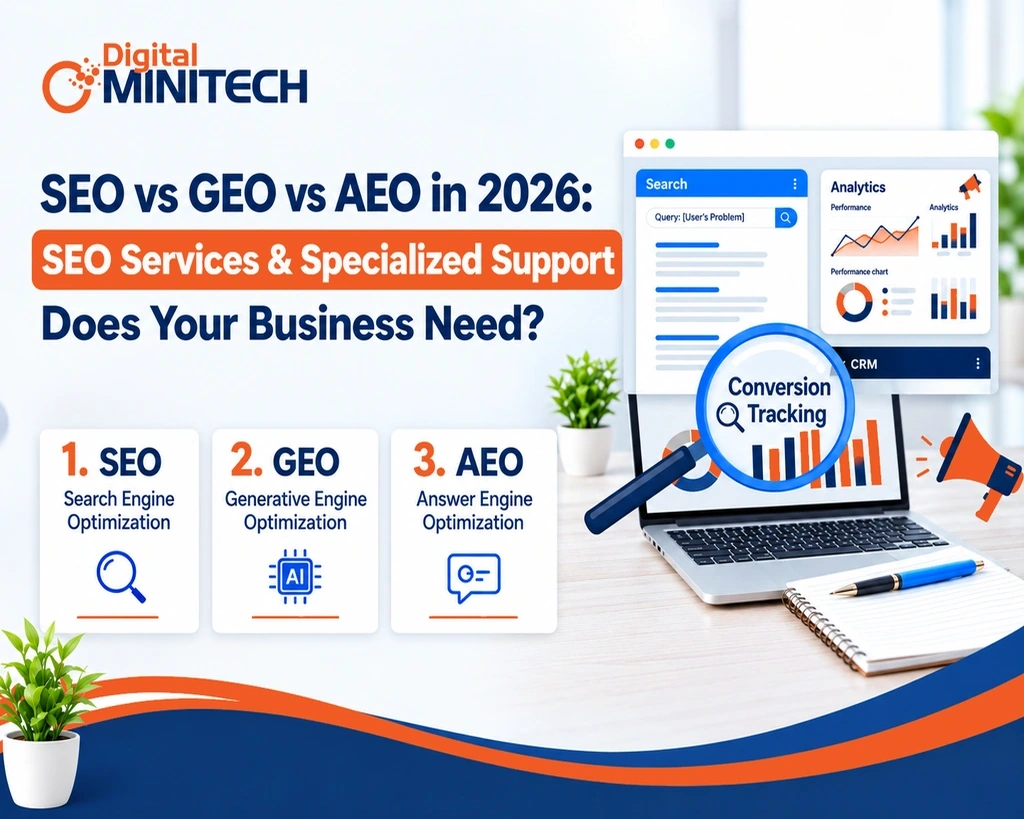
In this guide we will explain SEO versus GEO, versus AEO compare their benefits and share a checklist for choosing the right strategy for your business.
Key Takeaways
- SEO improves organic search visibility through relevant content, technical accessibility, and credibility.
- GEO helps make useful content more suitable for discovery and potential citation in AI-generated answers.
- AEO structures information so answer-focused search systems can identify relevant responses.
- SEO, GEO, and AEO share important foundations, including helpful content, clear organization, and trustworthy information.
- Companies should choose the most suitable approaches based on their target audience, business objectives, and available budget and resources.
- Results can be evaluated by monitoring organic website visits, conversion rates, brand references, and AI-generated citations when reliable tracking data is available.
What Is the Difference Between SEO, GEO, and AEO?
SEO, GEO, and AEO are three overlapping approaches to improving content visibility across search engines and answer-oriented platforms. For example, a digital marketing agency can optimize its service page for Google, structure answers to common questions, and provide credible information that AI systems may reference.
What Is Search Engine Optimization (SEO)?
Search Engine Optimization (SEO) is the practice of improving a website’s visibility in organic search results through relevant content, technical accessibility, and other quality and relevance signals. For example, an agency can target “digital marketing agency in Indore” with a useful service page and relevant local information.
What Is Generative Engine Optimization (GEO)?
Generative Engine Optimization (GEO) is the process of making content so it can be found, used and even cited in responses created by artificial intelligence. For instance a detailed guide that talks about SEO methods could offer useful details for an AI-generated answer about boosting local visibility.
What Is Answer Engine Optimization (AEO)?
Answer Engine Optimization (AEO) is the process of organizing and improving content so that search systems that look for answers can find and show the information. For example a web page that clearly answers the question “What’s technical SEO?” under a clear title can help make the explanation easier to read and take out.
Why Should Businesses Understand the Differences Between SEO, GEO, and AEO?
SEO, GEO and AEO matter because customers can find businesses through search results direct answers and experiences with generative AI. For example someone looking for an SEO agency might go to a Google result see a company in an AI-generated answer or find an answer, to a related question.
Moreover, businesses should adapt to these changing discovery methods without abandoning effective SEO fundamentals. Helpful content, crawlable pages, credible information, and a good user experience remain valuable across multiple search experiences.
What Are the Main Differences Between SEO, GEO, and AEO?
The main difference is the visibility each approach aims to improve, although their methods frequently overlap. For example, one well-researched service page can support organic rankings, answer-focused search experiences, and potential AI citations.
| Comparison | SEO | GEO | AEO |
| Main goal | Organic search visibility | Potential AI references and citations | Relevant direct answers |
| Focus | Rankings and website discovery | Useful, credible source material | Clear, extractable answers |
| Methods | Keywords, technical SEO, links | Evidence, context, clear structure | Direct answers, headings, suitable schema |
| Measurement | Clicks, rankings, conversions | Verified citations, mentions, referrals | Eligible appearances, visits, conversions |
At the same time, GEO and AEO are not universally standardized terms, and their definitions overlap across the industry. Neither approach guarantees rankings, featured answers, or AI citations.
How Can You Optimize Content for SEO, GEO, and AEO?
You can optimize content for SEO, GEO, and AEO by answering real customer questions clearly, supporting claims with evidence, and maintaining technically accessible pages. For example, a page about website audits can explain the process, show practical recommendations, and link to relevant service pages.
Use these practices:
- Understand search intent: Use keyword research for search intent to identify relevant questions and topics.
- Answer first: Give a concise, accurate response near the beginning of each important section.
- Organize information: Use descriptive headings, short paragraphs, examples, and relevant FAQs.
- Build credibility: Include accurate information, author details, original insights, and trustworthy references.
- Improve accessibility: Follow a technical SEO checklist to review crawling, indexing, internal links, and page performance.
- Use structured data appropriately: Apply relevant schema markup when eligible, but remember that schema does not guarantee enhanced search appearances or AI citations.
In addition, strengthen your on-page SEO best practices to help search systems understand the page and users navigate it more easily.
What Are the Main Benefits of SEO, GEO, and AEO?
SEO, GEO, and AEO can expand brand discovery through different search experiences, but their results depend on content quality, competition, platform behavior, and audience needs.
- SEO: Can attract relevant organic visitors and support long-term discoverability.
- GEO: Creates opportunities for brand mentions and source citations in generative AI responses.
- AEO: Makes information easier to identify and present in answer-oriented experiences.
For example, a local agency might attract visitors through its service pages, gain a mention in an AI-generated comparison, and answer common pricing questions through clearly structured content.
Which Search Optimization Strategy Does Your Business Need?
The right search optimization strategy depends on your business goals, audience, resources, and current online visibility. For instance, a newly launched local company might focus on improving its presence in Google search results, whereas an established content publisher may also track how often its content is referenced in AI-generated answers.
- Choose SEO first if your website needs organic traffic, stronger service-page visibility, or better technical performance.
- Prioritize AEO practices if customers frequently search for definitions, instructions, and straightforward answers.
- Add GEO-focused improvements if you want to understand how your brand appears in generative search experiences.
Ultimately, most businesses benefit from combining these approaches instead of treating them as competing strategies.
What Tools Can Help Track SEO, GEO, and AEO Performance?
A combination of free analytics tools, SEO platforms, and manual AI visibility checks can help measure performance across these approaches.
| Tool | Practical use |
| Google Search Console | Organic impressions, clicks, queries, and search performance |
| Google Analytics 4 | Website traffic, engagement, and conversions |
| Semrush or Ahrefs | Keyword research, backlinks, and competitor analysis |
| Screaming Frog | Technical crawling and website audits |
| Structured-data testing tools | Validate supported schema markup |
| AI search monitoring platforms | Track available brand mentions and citations |
Moreover, you can manually check relevant prompts in supported AI search platforms and record whether your brand or pages appear. These checks are snapshots, not exact measures of total audience reach.
How Do You Measure SEO, GEO, and AEO Performance?
Measure SEO, GEO, and AEO using separate indicators alongside business outcomes such as qualified leads, enquiries, and sales. For example, an agency can compare organic clicks from Search Console with referral visits and verified AI citations over the same reporting period.
Track these indicators monthly:
- SEO: Impressions, clicks, relevant rankings, organic sessions, and conversions.
- GEO: Verified citations, brand mentions, referral visits where available, and assisted conversions.
- AEO: Eligible search appearances, answer visibility where observable, referral visits, and conversions.
- Business outcomes: Qualified leads, enquiry quality, and revenue where tracking is available.
In addition, establish a baseline before making changes and document what you update. This helps you evaluate progress without attributing every change to one optimization method.
What Should Businesses Do Next to Combine SEO, GEO, and AEO?
Businesses should combine SEO, GEO, and AEO by improving existing high-value pages before creating unnecessary new content. For example, a service page with useful information but weak search visibility may benefit from better search-intent alignment, clearer answers, stronger internal links, and technical improvements.
Practical Implementation Checklist
- Audit existing pages for relevance, accuracy, and search performance.
- Identify high-value keywords and customer questions.
- Improve headings, opening answers, examples, and supporting evidence.
- Review crawling, indexing, internal links, and page experience.
- Add appropriate structured data where relevant.
- Check brand mentions and citations across selected AI search platforms.
- Record baseline metrics and review progress monthly.
Conclusion: Can SEO, GEO, and AEO Work Together?
SEO , GEO and AEO work together to make useful content easier to find easier to understand and more likely to be used across types of search. SEO improves a website’s visibility in search engine results, GEO aims to increase the chances of content being referenced in AI-generated responses, and AEO structures information to deliver clear, relevant answers to users’ questions.
Start by creating content and using solid technical SEO. Next, work on presenting information in a simpler, more understandable way., in AI-driven search results when it matters. An integrated search optimization strategy helps your business stay ahead. There is no need to follow every new trend to achieve meaningful results.
FAQs: SEO vs GEO vs AEO Search Optimization Strategy
1-How Do SEO, GEO, and AEO Differ from One Another?
SEO improves visibility in traditional organic search results, GEO focuses on potential visibility and citations in generative AI responses, and AEO helps answer-focused systems identify and present relevant information.
2. Is SEO still important in 2026?
Yes, SEO remains important for organic search visibility, relevant website traffic, and discoverability. Strong technical SEO, helpful content, and credible information also support broader search visibility.
3. What is Generative Engine Optimization (GEO)?
Generative Engine Optimization (GEO) is the practice of improving content’s suitability for discovery, use, and potential citation in AI-generated responses from platforms such as ChatGPT and Perplexity.
4. What is Answer Engine Optimization (AEO)?
Answer Engine Optimization (AEO) focuses on making content clear, structured, and relevant so answer-oriented search systems can identify and present useful answers to users’ questions.
5. Can SEO, GEO, and AEO work together?
Yes, SEO, GEO, and AEO can complement one another. Helpful content, clear headings, trustworthy information, and technical accessibility can support all three approaches.