+91 95752 60218

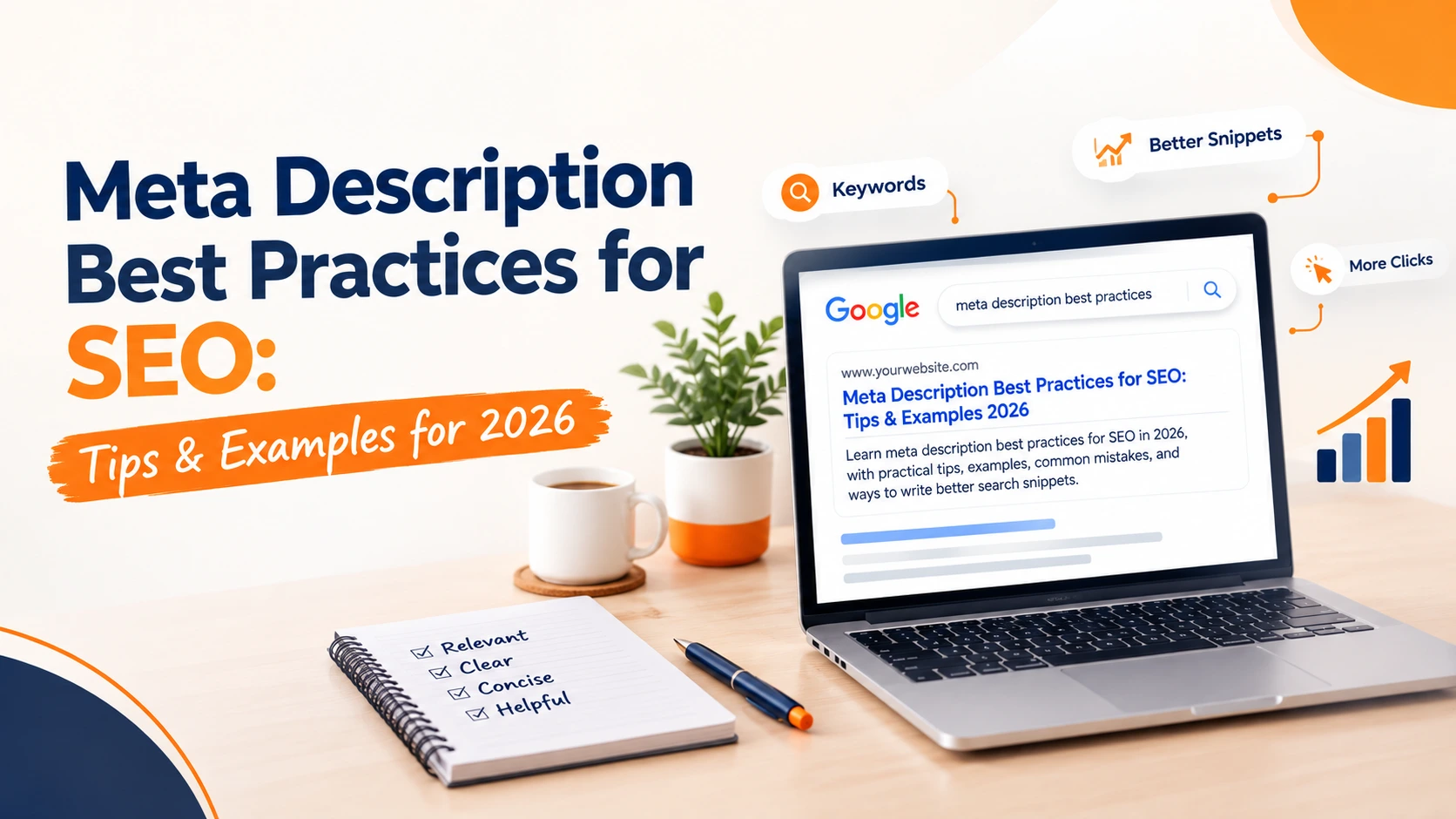
When you search for something on Google, you usually see three things first: the page title, the URL, and a short description underneath it.
That short description is often the meta description.
It may look like a small part of SEO, but it can play an important role in helping people understand what a webpage is about before they decide whether to click.
And here’s something many website owners get wrong:
Writing a meta description isn’t simply about adding your target keyword and keeping it under 160 characters.
Google can generate search snippets from the actual content on your page and may use your meta description when it provides a useful summary of the page. So, your description should be clear, relevant, and genuinely helpful to someone searching.
So, what makes a good meta description in 2026?
Let’s break it down.
What Is a Meta Description?
A meta description is an HTML element that provides a short summary of a webpage.
It usually looks something like this in the HTML:
<meta name=”description” content=”Learn practical SEO tips, strategies and examples to improve your website visibility and attract more qualified traffic.”>
You don’t normally see this text on the webpage itself.
Instead, Google may use it as part of the search result snippet.
For example, someone searching for:
“how to improve website SEO”
might see a search result containing a page title followed by a short description explaining what the page covers.
However, there’s an important detail here:
Google doesn’t guarantee that it will always display the exact meta description you write.
Google primarily creates snippets from the content on the webpage and may use the meta description when it believes it gives the searcher a better understanding of the page.
That’s why your meta description and your actual page content should always match.
Do Meta Descriptions Directly Improve Google Rankings?
This is probably one of the most common SEO questions.
The short answer is: don’t think of a meta description as a direct ranking shortcut.
Its more practical role is to help searchers understand what your page offers and decide whether the result is relevant to them.
Think about it this way.
Your page might appear on the first page of Google, but that doesn’t automatically mean everyone will click it.
Imagine seeing this:
SEO Services | SEO Company | SEO Agency | Best SEO Services
It doesn’t really tell you what you’re going to get.
Now compare it with:
Learn practical SEO strategies to improve Google visibility, attract relevant visitors and generate more qualified leads.
The second description gives the searcher context.
That’s what your meta description should do.
Why Do Meta Descriptions Matter for SEO?
Meta descriptions are small, but they can contribute to the overall search experience in several ways.
1. They explain the page
A good description gives people an idea of what they’ll find after clicking.
2. They can make your result more relevant
When the wording matches the user’s search intent, the result can become easier to understand.
3. They set expectations
If you promise a detailed guide, the page should actually provide a detailed guide.
4. They support your search-result presentation
Your title and description work together to communicate what your page is about.
5. They can improve the quality of your search snippets
Google recommends creating useful, descriptive meta descriptions for important pages rather than relying on generic or repetitive descriptions.
However, remember that Google may still choose different text from your page when generating the final snippet.
How Long Should a Meta Description Be in 2026?
This is where SEO gets unnecessarily complicated.
You may have heard:
“A meta description must be between 150 and 160 characters.”
That’s not a strict Google rule.
Google doesn’t specify a fixed maximum length for meta descriptions. Search snippets can be shortened depending on the available space, particularly across different devices.
So instead of obsessing over an exact character count, focus on making your description:
- Clear
- Concise
- Relevant
- Useful
- Natural
- Focused on the page’s actual topic
As a practical SEO approach, keeping your description reasonably concise is still a good idea because you want the important information to appear early.
The goal isn’t to win a character-count competition.
The goal is to make the searcher understand your page quickly.
10 Meta Description Best Practices for SEO in 2026
1. Write a Unique Description for Every Important Page
One of the easiest mistakes to make is using the same meta description on multiple pages.
For example:
Digital marketing services to grow your business online. Contact us today.
If you use something similar on your SEO page, Google Ads page, social media page and blog posts, you’re missing an opportunity to explain what each page is actually about.
Instead, make each description specific.
SEO Page
Improve your Google visibility with technical, on-page, local and off-page SEO strategies designed to attract relevant traffic and qualified leads.
Google Ads Page
Reach high-intent customers with Google Ads campaigns focused on targeted traffic, lead generation, conversion tracking and measurable performance.
Social Media Page
Build a stronger social media presence with strategic content, audience-focused campaigns and platform-specific marketing for your business.
Every important page deserves its own description.
2. Match the Search Intent
Before writing a meta description, ask yourself:
What does someone searching this keyword actually want?
For example, someone searching:
“meta description best practices”
is probably looking for practical advice, examples and optimization tips.
So this:
Learn the latest meta description best practices, including optimization tips, examples and common mistakes to avoid in 2026.
is much more relevant than:
Digital marketing company offering SEO and online marketing services.
The second description might describe a company, but it doesn’t answer the searcher’s immediate question.
Search intent should always come first.
3. Include Your Main Keyword Naturally
If your target keyword is:
meta description best practices
there’s nothing wrong with using it naturally.
For example:
Learn meta description best practices, including SEO tips, examples and common mistakes to avoid when optimizing your website in 2026.
The keyword fits naturally.
What you shouldn’t do is this:
Meta description best practices, SEO meta description, best meta descriptions, meta description SEO, SEO description best practices.
That’s not helpful to anyone.
Use keywords naturally. Don’t turn your meta description into a keyword list.
4. Focus on Benefits, Not Just Features
Your description shouldn’t simply tell users what the page contains.
Where appropriate, show them what they’ll get from reading it.
Weak:
SEO guide covering meta descriptions, keywords and search snippets.
Better:
Learn how to write useful meta descriptions with practical examples and SEO tips that make your search snippets clearer and more relevant.
The second version gives the reader a reason to click.
That’s the difference between simply describing content and communicating value.
5. Be Specific
Generic descriptions are easy to ignore.
Compare:
Learn more about SEO and digital marketing.
with:
Discover 10 practical meta description techniques, real examples and common mistakes to avoid when optimizing pages for search.
The second one tells the user exactly what they can expect.
Specificity makes your description more useful.
6. Make Sure the Description Matches the Page
This sounds obvious, but it’s surprisingly common.
Don’t write a description just because a keyword has good search volume.
Write it based on what the page actually provides.
For example, if your description says:
Complete guide to technical SEO covering crawling, indexing, Core Web Vitals and structured data.
then the page should actually discuss those topics.
If someone clicks expecting one thing and finds something completely different, you’ve created a poor user experience.
Good SEO isn’t just about getting the click.
It’s also about earning the click by setting the right expectation.
7. Use a Call to Action When It Makes Sense
A call to action can sometimes make a description more engaging.
You can use phrases such as:
- Learn how it works
- Explore practical examples
- Get the complete guide
- Discover useful strategies
- See the step-by-step process
For example:
Learn how local SEO works, which factors influence Google Maps visibility and what businesses can do to attract more local customers.
However, don’t force a CTA into every description.
Sometimes the best call to action is simply explaining exactly what the reader will find.
8. Put the Important Information First
Search snippets may be shortened depending on available display space.
So don’t save your most important information for the end.
Instead of:
If you’re interested in learning more about SEO and want to understand how businesses can improve their online visibility, this guide explains…
Try:
Learn how to write better meta descriptions with practical SEO tips, examples and common mistakes to avoid.
The second version gets to the point much faster.
9. Write for Humans, Not Just Search Engines
This is one of the most important SEO rules.
Don’t write descriptions like:
SEO Services | SEO Company | SEO Agency | SEO Expert | Best SEO Services | SEO India
It might contain your keywords, but it doesn’t communicate anything useful.
Instead:
Discover practical SEO strategies for improving search visibility, attracting relevant traffic and turning more website visitors into potential customers.
Much better.
Your meta description should sound like something a person would actually want to read.
10. Review Important Meta Descriptions Regularly
Your website isn’t static.
Your services change.
Your content gets updated.
Your target audience can change.
Your business may start targeting new locations or industries.
So your meta descriptions should also be reviewed when important pages are updated.
For example, if an article originally says:
Complete SEO guide for 2024
but you’ve completely updated it for 2026, the description should reflect the current content.
Don’t update every description just for the sake of updating it.
Review them when the page or search intent has actually changed.
Meta Description Examples for Different Types of Pages
Let’s make this practical.
Homepage
Example:
Digital OmniTech helps businesses grow online with SEO, paid advertising, social media marketing, web development and conversion-focused digital strategies.
SEO Service Page
Example:
Improve your Google visibility with technical, on-page, local and off-page SEO strategies designed to attract relevant traffic and qualified leads.
If you want to build a stronger technical foundation for your website, you can also explore our Technical SEO Services.
Local SEO Page
Example:
Improve your local search visibility and connect with nearby customers through Google Business Profile optimization, local SEO and location-focused strategies.
For businesses that rely on local customers, a strong Local SEO strategy can work alongside well-optimized website content and local landing pages.
Google Ads Page
Example:
Generate targeted leads with Google Ads campaigns built around keyword research, conversion tracking, campaign optimization and measurable business goals.
Social Media Marketing Page
Example:
Build a stronger social media presence with strategic content, audience-focused campaigns and social media marketing designed around your business goals.
You can learn more about our Social Media Marketing Services if you’re looking to connect your social strategy with your wider digital marketing efforts.
eCommerce SEO Page
Example:
Improve your online store’s search visibility with ecommerce SEO strategies for product pages, category pages, technical SEO, content and organic growth.
For ecommerce businesses, eCommerce SEO Services can help address optimization beyond just the homepage.
Meta Description vs Title Tag: What’s the Difference?
These two are often confused.
| Element | Main Purpose |
| Title Tag | Tells users and search engines what the page is about |
| Meta Description | Gives users a short summary of the page |
| URL | Shows the webpage’s location |
For example:
Title
Meta Description Best Practices for SEO: Tips and Examples for 2026
Meta Description
Learn how to write better meta descriptions with practical SEO tips, examples and common mistakes to avoid in 2026.
The title establishes the topic.
The description provides additional context.
Together, they help searchers understand what your result is about.
But remember: Google can automatically generate title links and snippets based on the page content, search query and other signals. So the exact text you provide isn’t guaranteed to be what appears in every search.
How to Write a Meta Description: A Simple 5-Step Process
If you’re managing dozens or hundreds of pages, you don’t need to overcomplicate this.
Use this simple process.
Step 1: Identify the Page Topic
Ask:
What is this page actually about?
Don’t start with keywords.
Start with the page.
Step 2: Understand Search Intent
What is the person searching for?
Are they trying to:
- Learn something?
- Compare options?
- Find a service?
- Buy something?
- Solve a problem?
Step 3: Identify the Main Value
What will the visitor get from the page?
Step 4: Write Naturally
Put the topic and value into one clear description.
Step 5: Edit It
Remove:
- Repeated keywords
- Unnecessary words
- Generic statements
- Unclear phrases
Then ask:
“If I saw this in Google, would I understand what I’ll get after clicking?”
If yes, you’re probably on the right track.
Meta Descriptions Are Only One Part of SEO
It’s easy to spend too much time worrying about one small SEO element.
A great meta description cannot fix a page with poor content, weak search intent, technical problems or a confusing user experience.
SEO works as a bigger system.
Your content needs to answer real questions.
Your website needs to be technically accessible.
Your internal linking should help users discover relevant pages.
Your pages need to provide genuine value.
And your website should make it easy for visitors to take the next step.
For example, if you’re working on the technical side of your website, you can explore our Technical SEO Services to understand how technical factors fit into a broader SEO strategy.
If your business depends heavily on local customers, you can also look at our Local SEO Services.
And if you’re running an online store, SEO needs to go beyond the homepage. Product pages, category pages, technical elements and content all matter. That’s where our eCommerce SEO Services can be relevant.
The point is simple:
Don’t treat one SEO element as the entire SEO strategy.
How Internal Linking Supports Your SEO Strategy
Internal links are another part of a well-structured website.
Suppose someone lands on this article because they’re researching meta descriptions.
They may eventually want to learn:
- How technical SEO works
- How local SEO works
- How ecommerce SEO works
- How to create a complete digital marketing strategy
Instead of making the visitor search for those resources themselves, relevant internal links can guide them to the next useful page.
For example, if you’re planning your wider marketing strategy, you can read our guide:
How to Create a Digital Marketing Plan: Step-by-Step
This gives the reader a logical next step instead of simply adding a random internal link.
That’s how internal linking should work.
Help the user first. SEO benefits follow naturally.
Common Meta Description Mistakes to Avoid
❌ Using the Same Description Everywhere
Your homepage, service pages and blog posts shouldn’t all have the same description.
❌ Keyword Stuffing
Repeating the same keyword multiple times doesn’t make the description better.
❌ Being Too Generic
“Learn more about our services” tells the searcher almost nothing.
❌ Misrepresenting the Page
Don’t promise information that the page doesn’t contain.
❌ Writing Only for Search Engines
Remember that people are the ones deciding whether to click.
❌ Treating 160 Characters as a Strict Rule
There isn’t a universal Google rule saying every meta description must be exactly 150–160 characters.
❌ Ignoring Important Pages
Review important service, category, product and landing pages – not just blog posts.
A Quick Meta Description Checklist for 2026
Before publishing or updating a page, ask:
☑ Is the description unique?
☑ Does it accurately describe the page?
☑ Does it match the search intent?
☑ Is the main topic clear?
☑ Is the target keyword included naturally where appropriate?
☑ Does it explain the value of the page?
☑ Is it written for humans?
☑ Have unnecessary keywords been removed?
☑ Does it match the actual content?
☑ Have important pages been reviewed after major updates?
If the answer is yes to most of these, your meta description is probably doing its job.
Frequently Asked Questions
What is a meta description in SEO?
A meta description is an HTML element that provides a short summary of a webpage. Google may use it in the search result snippet when it considers it a useful description of the page.
What is the ideal length of a meta description in 2026?
There is no fixed character limit set by Google. Search snippets can be truncated depending on the available space and device, so focus on writing a concise and useful description rather than targeting an exact number.
Do meta descriptions improve rankings?
A meta description shouldn’t be treated as a direct ranking shortcut. Its main purpose is to accurately describe the page and help searchers understand whether the result is relevant.
Should every page have a unique meta description?
For important pages, yes. Unique descriptions help communicate what makes each page different and relevant.
Can Google rewrite my meta description?
Yes. Google may generate a snippet from content on your webpage instead of using the exact meta description you provided.
Should I add keywords to my meta description?
You can include relevant keywords naturally when they accurately describe the page. Avoid keyword stuffing.
Can I write different meta descriptions for mobile and desktop?
You generally don’t need separate descriptions. Focus on writing one useful description for the page. Google may display different portions depending on available space.
How often should I update meta descriptions?
Review them when the page content, search intent, target audience or business offering changes. You don’t need to rewrite every description simply because a new year has started.
Final Thoughts
Meta descriptions may only take a few seconds to read, but they are part of the first impression your website can make in search results.
The biggest mistake is treating them as a place to insert as many keywords as possible.
Instead, think of your meta description as a short introduction to your webpage.
Tell the searcher what they will find.
Make the value clear.
Keep the wording natural.
Match the search intent.
And most importantly, make sure the page delivers what the description promises.
Don’t worry if Google doesn’t always show the exact description you’ve written. Search snippets are generated dynamically, and Google may use content from the page when it believes that provides a better answer for the searcher.
Good SEO isn’t about controlling every line Google displays.
It’s about giving Google and more importantly, your visitors – the clearest possible understanding of what your page is about.
Write for the person who is searching first. Optimize for search engines second.