+91 95752 60218

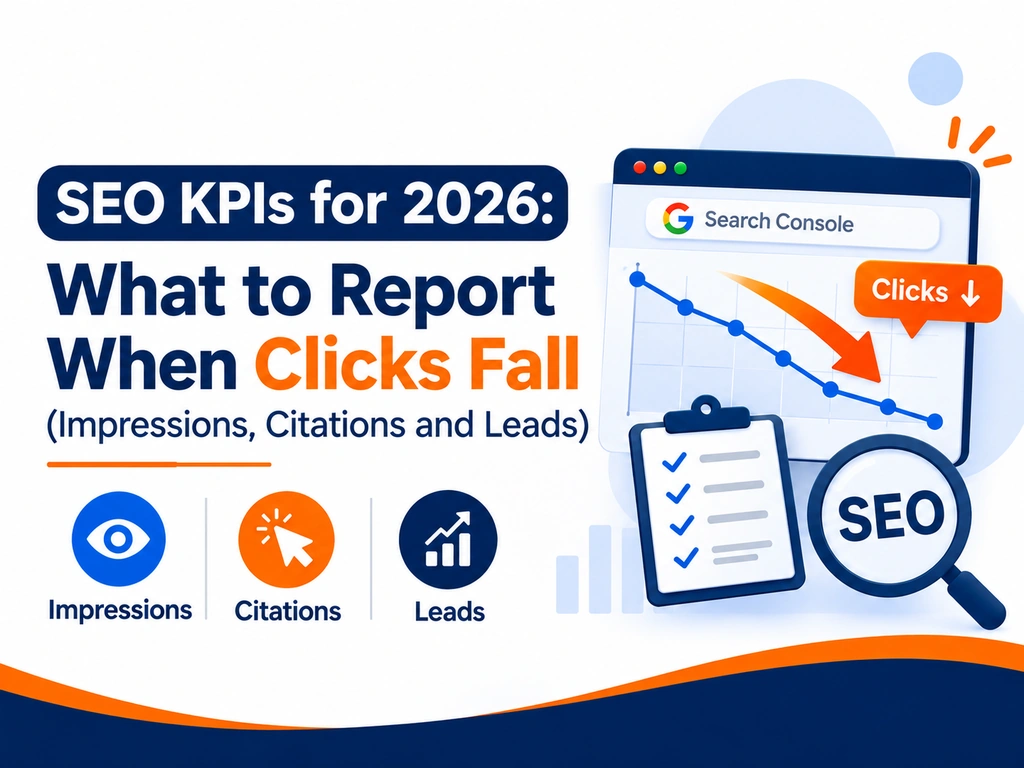
You’ve probably been tracking keyword rankings, organic clicks and website traffic to measure SEO performance.
But what happens when impressions increase, clicks decline and your brand starts appearing in AI-generated answers?
Understanding why websites get impressions but fewer clicks can help identify potential SEO performance issues and your brand starts appearing in AI-generated answers?
In this guide, we’ll explain which SEO KPIs matter in 2026 and how to report visibility, AI citations and qualified leads.
Key Takeaways
- SEO KPIs measure how effectively organic search contributes to visibility, traffic, leads and business growth.
- Search impressions help measure visibility when organic clicks decline.
- AI search visibility depends on how often a brand is referenced or cited in AI-generated responses.
- Google Search Console provides performance data such as total impressions, clicks, click-through rate (CTR) and average search ranking.
- Google Analytics 4 measures organic sessions, engagement and conversions.
- Organic leads and revenue help demonstrate the business value of SEO.
- Effective SEO reports combine performance data, explanations and next-month actions.
What Are SEO KPIs in 2026?
SEO KPIs are measurable indicators used to evaluate how effectively organic search contributes to website visibility, traffic, leads, conversions and business objectives.
In 2026, SEO reporting requires more than checking keyword positions. Businesses should understand how SEO and content marketing performance are measured to evaluate traffic quality, engagement and conversions.
. Businesses also need to understand search visibility, engagement, AI search presence and customer acquisition through the right digital marketing metrics.
For example, a website might receive fewer clicks but generate more qualified enquiries through its organic landing pages. Businesses can improve these outcomes with the right SEO services.
Why Do SEO KPIs Matter More in 2026?
SEO KPIs are important because search behaviour is changing due to AI-powered search experiences, including AI Overviews, AI Mode and zero-click searches. For example, a person may discover a brand through an answer without immediately visiting the brand’s website.
Businesses can monitor their AI search presence to understand how often their brand appears in AI-generated answers.
Therefore, businesses should measure both SEO KPIs and business outcomes. However, a decline in clicks still requires investigation rather than automatically being blamed on AI search.
| Traditional SEO reporting | Modern SEO reporting |
| Keyword rankings | Search visibility |
| Organic clicks | Impressions and CTR |
| Website traffic | Engagement quality |
| Backlinks | AI mentions and citations |
| Total conversions | Qualified leads and revenue |
Which SEO KPIs Should Businesses Track in 2026?
Businesses should track five categories of SEO performance metrics to understand their complete search journey.
1. Organic Search Visibility KPIs
Search visibility KPIs measure how frequently your website appears in search results.
Track:
- Total impressions and clicks.
- Average click-through rate (CTR).
- Average position.
- Keyword ranking distribution.
- Branded versus non-branded searches.
For example, increasing impressions can indicate broader search exposure, even when clicks decrease.
Explore how to improve Google search visibility.
2. Organic Traffic and Engagement KPIs
Organic traffic KPIs measure how visitors interact with a website after arriving through search results. I watch traffic KPIs by looking at organic sessions, engaged sessions, engagement rate, landing pages, device performance and returning visitors.
For example, a service page that attracts visitors but generates longer visits and more enquiries may be improving its business value.
3. AI Search Visibility
KPIs measure how often a brand or website appears in AI-generated answers as a mention or cited source. I find AI Search Visibility KPIs useful for understanding where a brand shows up.
Track:
- Google AI Overviews appearances through available monitoring methods.
- ChatGPT and Perplexity brand mentions.
- Verified website citations.
- AI referral sessions.
- AI-referred conversions.
Important: Google Search Console does not provide a complete, dedicated AI Overviews citation or impression report. Separate monitoring and manual checks are needed.
4. Lead Generation and Conversion KPIs
SEO conversion KPIs determine if organic visitors perform actions that bring business value.
Track form submissions, phone calls, WhatsApp enquiries, consultation bookings, qualified leads and sales‑qualified leads (SQLs).
For instance, twenty relevant enquiries can bring value than two hundred visits that yield no business opportunities.
5. SEO Efficiency and Business Impact KPIs
Business impact KPIs link SEO investment to commercial results.Track organic revenue, cost per lead, lead‑to‑customer conversion rate and SEO ROI.
SEO success is measured by more than traffic; it is also measured by qualified leads, conversions, customer acquisition and revenue that comes from organic search.
How Do You Measure SEO Performance When Organic Clicks Decline?
SEO performance measurement involves comparing impressions, clicks, CTR, rankings, engagement and conversions before deciding whether performance has declined.
Understanding SEO and content marketing performance can help businesses evaluate the effectiveness of their organic search efforts.
Consider this illustrative example, not industry benchmark data:
| Metric | Previous period | Current period |
| Impressions | 50,000 | 65,000 |
| Clicks | 3,000 | 2,600 |
| CTR | 6% | 4% |
| Organic leads | 45 | 52 |
The website gained visibility but received fewer clicks. However, organic leads increased.
To understand this change:
- Compare clicks and impressions over identical periods.
- Investigate CTR changes by query and landing page.
- Check average position and ranking distribution.
- Separate branded and non-branded searches.
- Compare mobile and desktop performance.
- Investigate search result features and competitors.
- Review organic leads before judging overall performance.
Also, check technical SEO factors that affect search visibility.
How Can You Track AI Search Visibility and SEO Leads?
AI citations, brand mentions and referral visits are three ways to measure online performance.
- An AI citation happens when an AI-generated response includes your website as a source.
- A brand mention occurs when an AI platform names your business or brand, even if no direct link is included.
- A referral visit means someone lands on your website through a referral from an AI platform and that source can be tracked.
At the time, Google Analytics 4 helps track how users find your site organically and how they convert.
Google Search Console gives insight into search queries, how often your site appears in results, how many clicks it gets and how landing pages perform.
Make sure to connect form submissions, phone calls and WhatsApp messages to tracking events.
Whenever you can, use data from your CRM to tell the difference between leads that’re qualified and those that are not.
Which Tools Are Best for Tracking SEO KPIs in 2026?
SEO reporting tools help collect, analyse and present different performance indicators.
| Tool | What to measure |
| Google Search Console | Impressions, clicks, CTR and position |
| Google Analytics 4 | Sessions, engagement and conversions |
| Google Tag Manager | Forms, calls and button events |
| Semrush | Rankings and competitors |
| Ahrefs | Backlinks and organic keywords |
| Looker Studio | SEO dashboards |
| Screaming Frog | Technical SEO audits |
For AI search monitoring, third-party visibility platforms and manual prompt checks can identify mentions and citations. Remember that estimated visibility scores are not verified Google Search Console data.
What Should an SEO Report for Clients Include?
An effective SEO report template connects performance numbers with business objectives and recommended actions. A well-structured digital marketing plan with clear business objectives and measurable KPIs helps businesses turn performance insights into actionable improvements.
Use this monthly reporting checklist:
- Reporting. Business objectives.
- Organic impressions, clicks, CTR and position.
- Top‑performing landing pages.
- Non‑branded keyword performance.
- Organic. Engagement.
- Verified AI. Brand mentions.
- Organic. Qualified enquiries.
- Revenue and SEO ROI, where measurable.
- Completed SEO activities.
Issues identified and month’s action plan.
Sample executive summary: Organic impressions increased this month, while clicks declined due to CTR. Organic enquiries improved from 45 to 52. Month, we will investigate query‑level CTR changes, improve important landing pages and monitor AI search visibility.
What’s Next? Build a Better SEO Reporting Strategy for 2026
A consistent SEO reporting process helps businesses understand progress and identify improvement opportunities.
Start by establishing baseline KPIs. Then compare month-over-month and year-over-year results, segment branded searches, monitor AI visibility separately and review qualified leads.
For stronger business outcomes, explore SEO strategy for B2B businesses and consider professional SEO services and performance optimization.
Conclusion: Measure SEO Success Beyond Clicks
SEO KPIs in 2026 should focus on visibility, traffic, engagement, AI search presence, qualified leads and business results.
Clicks still matter,. They do not tell the full story of the customer journey. By using Google Search Console, GA4, conversion tracking and clear reporting, businesses can see how SEO truly impacts their goals.
Have questions about your SEO performance?Contact our team to discuss your website’s search visibility, traffic and growth opportunities.
Frequently Asked Questions About SEO KPIs in 2026
1. What Are the Most Important SEO KPIs to Track in 2026?
The most important SEO KPIs include organic impressions, clicks, CTR, keyword rankings, organic sessions, AI search visibility, qualified leads, conversion rates and revenue. Tracking these metrics together helps businesses understand search performance and its contribution to business growth.
2. How Do You Measure SEO Success When Organic Clicks Decline?
Compare impressions, CTR, keyword positions, landing-page performance and organic conversions. If impressions and qualified leads increase while clicks decline, investigate search behaviour and conversion quality before concluding that SEO performance has worsened.
3. How Can You Track AI Overviews and AI Search Citations?
Use Google Search Console’s Generative AI Performance Report for available Google AI search visibility data. For ChatGPT and Perplexity, use third-party monitoring tools and manual searches to identify brand mentions, website citations and referral traffic.
4. Which Google Search Console Metrics Should You Include in SEO Reports?
Include total clicks, impressions, average CTR, average position, top-performing queries and landing-page performance. Segment the data by device, country and branded versus non-branded searches to identify meaningful performance changes.
5. How Do You Calculate SEO ROI and Cost Per Organic Lead?
SEO ROI measures the financial return generated through SEO compared with its investment.
- Cost per organic lead: Total SEO investment ÷ Organic leads.
- SEO ROI: ((Revenue attributable to SEO − SEO investment) ÷ SEO investment) × 100.
For example, if you spend ₹20,000 on SEO and generate 40 organic leads, your cost per lead is ₹500. Use actual customer revenue and attribution data when calculating ROI.