+91 95752 60218


If you work in SEO, you already know that fresh content and fast discovery matter in Google Search. However, on October 8, 2026, Google introduced its UGC Fresh Data Program, offering eligible platforms a specific method to provide updated user-generated content and interaction data.. In this guide, we’ll explain how it works, who qualifies, and what SEO professionals should do next.
Key Takeaways
- UGC Fresh Data Program helps approved platforms submit fresh user-generated content and interaction signals to Google.
- Eligibility focuses on high-volume platforms hosting public forums, social posts, and other independent user contributions.
- Technical requirements include OAuth 2.0 authentication, valid structured data, and stable public URLs.
- Freshness matters: Google recommends submitting content within minutes and updating engagement counters within 72 hours.
- Indexing is not guaranteed: Participation does not guarantee that content will appear in Google Search.
- Ordinary websites should continue using crawlable pages, internal links, sitemaps, and relevant structured data.
What Is Google’s UGC Fresh Data Program?
Google’s UGC Fresh Data Program is a project that allows approved platforms to send new user-generated content, known as UGC and interaction signals directly to Google Search using a dedicated pipeline.
UGC also contains content made by users, such as forum discussions and social media posts. For example a public discussion platform could send a published thread together with engagement data. Unlike web crawling this program offers an approved route, for eligible platforms to submit content. This program is made for trending UGC not for website articles.
Why Does the UGC Fresh Data Program Matter for SEO?
The program is important because it gives platforms that qualify a way to get user conversations and activity signals processed quickly for Google Search.
For instance a moving public forum might share discussions about a topic that is changing quickly. Quicker processing might help Google find contributions earlier but it does not ensure better rankings being listed in search results or appearing in search results.
Also the announcement points out a difference: faster delivery of content is not the same, as better rankings. The quality of content how relevant it is, how easy it is to access and Googles search systems still play a role.
Who Is Eligible for Google’s UGC Fresh Data Program?
The program targets platforms with substantial volumes of public, authentic user-generated content and the technical ability to meet Google’s requirements. Google does not publish a specific minimum audience size or post count.
What Are the Main Eligibility Requirements?
Eligible platforms must meet these conditions:
- Content type: Primarily host user-generated posts, social content, or forum discussions.
- Public access: Make content accessible to Googlebot and users without login restrictions or paywalls.
- Dedicated URLs: Give individual contributions stable, publicly accessible pages.
- Creator attribution: Connect content to creators with public profiles.
- Content moderation: Maintain active moderation and a user-reporting mechanism.
- Technical setup: Enable secure OAuth 2.0 authentication and ensure JSON-LD structured data meets validation requirements.
- Freshness: Submit new content promptly and refresh engagement counters within the required window.
For example, a large discussion forum with public threads and active moderation may fit the program’s intended audience. A typical company blog publishing staff-written articles is unlikely to qualify simply because readers can leave comments.
How Is the UGC Fresh Data Program Different From the Indexing API?
The UGC Fresh Data Program is a dedicated ingestion pipeline for approved UGC platforms, whereas the Indexing API serves specific supported content types.
| Feature | UGC Fresh Data Program | Indexing API | Standard crawling |
| Intended use | Eligible UGC platforms | Supported job postings and livestream pages | General public web pages |
| Access | Approval required | API eligibility requirements | Googlebot discovery |
| Submission | Dedicated UGC pipeline | API notifications | Crawling and links |
| Guarantee of indexing | No | No | No |
Moreover, the Indexing API is not a general-purpose indexing shortcut for ordinary blog posts. Most websites should continue to rely on crawlable pages, internal links, and XML sitemaps.
What Technical Requirements Should SEO Teams Know?
The technical requirements combine secure authentication, structured data, public accessibility, and timely submission. Google says detailed integration documentation will be provided to platforms selected for the program.
How Should Platforms Prepare Their Data?
First make sure that every user contribution has an URL and a clear creator. Next check that your structured data really shows the content and how people interact with it.
For example you might use types such as Social Media Posting or Discussion Forum Posting and add the proper interaction Statistic properties. Check your work, against Googles documentation instead of assuming that any valid schema will automatically make your platform qualify.
Which SEO Tools Can Help You Prepare?
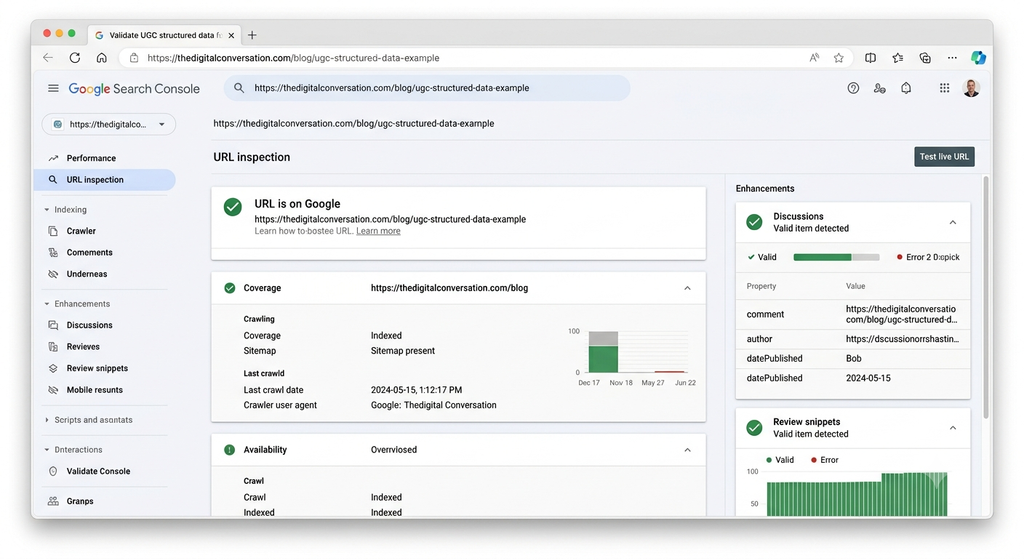
SEO tools help website owners monitor crawlability, structured data, and organic performance, even when their websites do not qualify for the program.
| Tool | Practical use |
| Google Search Console | Monitor indexing and organic search performance |
| Rich Results Test | Check supported structured data features |
| URL Inspection | Review Google’s information about an individual URL |
| Schema Markup Validator | Validate general schema.org markup |
For example, use Google Search Console to investigate whether important public pages are indexed and receiving impressions. Remember that these tools do not provide access to the UGC Fresh Data Program itself.
What Should SEO Professionals Do Next?
SEO professionals should first determine whether their websites qualify, then strengthen their existing search foundations.
Use this practical checklist:
- Confirm that your platform primarily hosts independent user-generated content.
- Ensure each post has a permanent URL that anyone can access publicly.
- Verify creator attribution and moderation processes.
- Review OAuth 2.0 and JSON-LD implementation readiness.
- Prepare a process for submitting fresh content promptly.
- Ensure engagement counters can be updated within 72 hours.
- Review Google’s official UGC Fresh Data Program documentation.
- If eligible, submit an application and wait for Google’s response.
Google says applicants should expect a response about their application status within 6–8 weeks, but acceptance is not guaranteed.
Moreover, if you operate a standard business website or content blog, focus on useful content, internal linking, XML sitemaps, and technical SEO rather than trying to access a program designed for large UGC platforms.
Conclusion: What Does the UGC Fresh Data Program Mean for SEO?
Google’s UGC Fresh Data Program creates a dedicated submission pathway for approved platforms publishing fresh, authentic user-generated content. It is not a replacement for traditional crawling or a shortcut to higher rankings.
Ultimately, eligibility, content quality, technical readiness, and timely data submission are the key considerations. If your website falls short of these standards, improve crawlability, include relevant data, and publish useful content to support lasting growth in organic search results.
Frequently Asked Questions About Google’s UGC Fresh Data Program
1. What Does Google’s UGC Fresh Data Program Involve?
Google’s UGC Fresh Data Program is a dedicated content-submission initiative for eligible platforms that publish user-generated content, such as public forum discussions and social posts. It helps Google process fresh content and engagement signals.
2. Who can apply for Google’s UGC Fresh Data Program?
Platforms that host substantial volumes of public user-generated content may be eligible. They should provide stable URLs, creator attribution, content moderation, and the required technical integration.
3. Does the UGC Fresh Data Program guarantee faster indexing?
No, participation does not guarantee faster indexing or inclusion in Google Search. Google retains control over crawling, indexing, and ranking decisions.
4. Is the UGC Fresh Data Program available for ordinary blogs?
The program is primarily intended for eligible user-generated content platforms. Standard business websites and editorial blogs should continue using XML sitemaps, internal links, and Google Search Console.
5. What technical requirements does the program have?
The stated requirements include OAuth 2.0 authentication, valid structured data, publicly accessible URLs, creator attribution, and active content moderation. Eligible platforms should follow Google’s official technical documentation.