+91 95752 60218

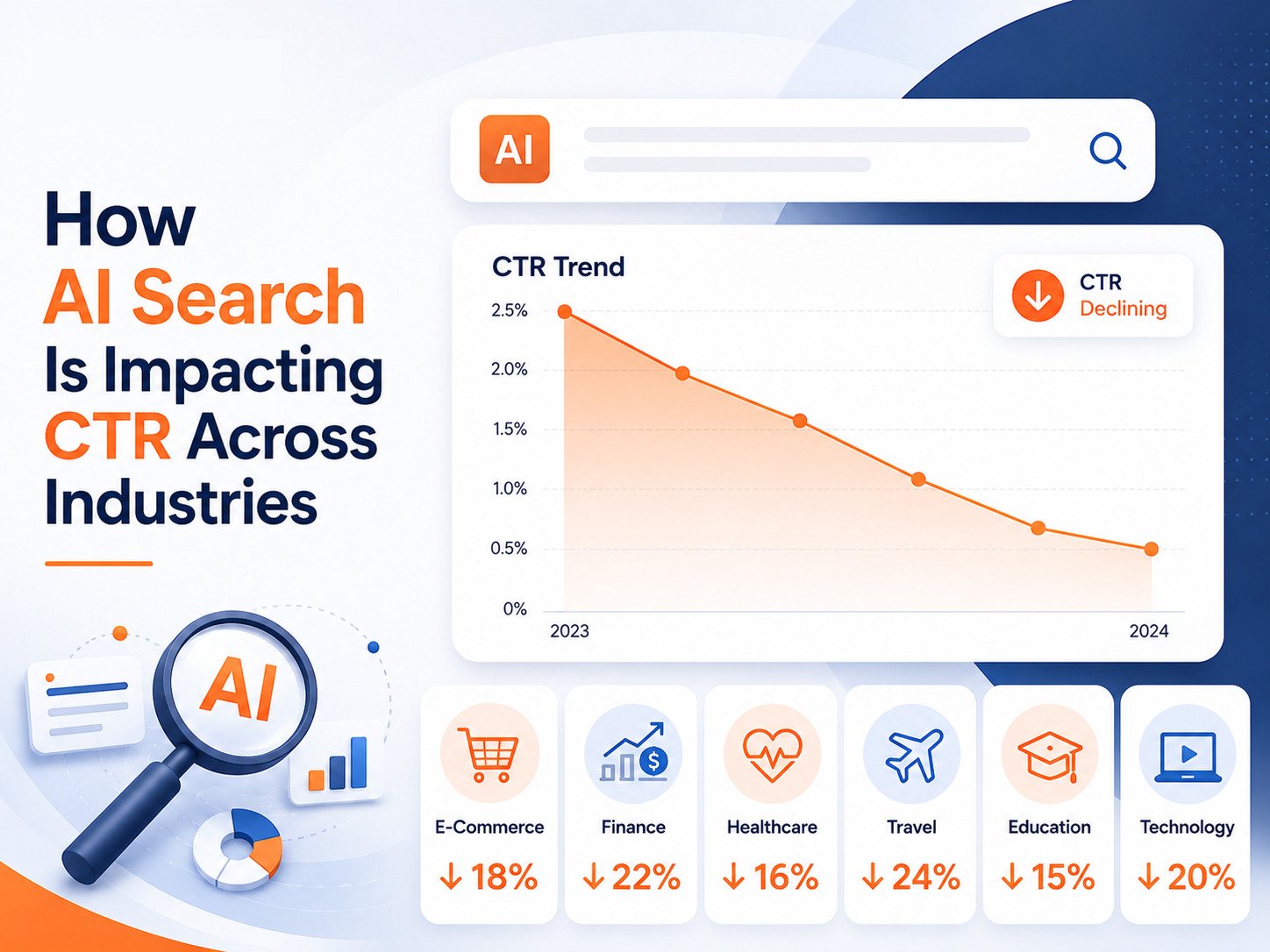
Search is moving from a traditional list of blue links toward an experience where users can receive complete answers directly on the search results page. AI Overviews, conversational search, and answer engines are changing how people discover information, compare businesses, research products, and make purchasing decisions. This transformation is creating a major shift in one of the most important SEO metrics: click-through rate (CTR).
For years, ranking on the first page of search results was the primary objective of organic search. A strong position generally meant more impressions and more clicks. AI search is changing that relationship. When a search engine provides a detailed summary before traditional results, users may find the information they need without clicking through to another website. This phenomenon is often described as zero-click search, and it is becoming increasingly important for businesses across industries.
The impact is not identical for every website. Informational queries may experience significant reductions in traditional organic clicks, while websites that are selected as sources within AI-generated answers can gain highly relevant visibility. This means businesses need to think beyond rankings and optimize for ai search visibility, brand recognition, authority, and the quality of traffic generated from search.
What Is Happening to CTR in AI Search?
Traditional search behavior generally follows a simple pattern: a user enters a query, scans the results, selects a relevant page, and visits the website. AI search introduces another stage. Instead of simply presenting links, the search engine may summarize information from multiple sources and answer the user’s question directly. For broad informational searches, this can reduce the need to visit individual websites.
A user searching for an explanation, comparison, definition, or basic recommendation may receive enough information from the AI-generated response itself. Industry studies and available search observations have reported substantial CTR declines when generative summaries appear, with some estimates suggesting reductions of roughly 35% to 65% for traditional organic clicks depending on the query, industry, and search experience.
The exact impact varies considerably, so this range should not be treated as a universal benchmark. The important point is that impressions and rankings no longer tell the complete story. A page can maintain visibility while receiving fewer traditional clicks, or it can lose some conventional clicks while gaining valuable exposure through an AI-generated answer.
Why AI Search Changes User Behavior
AI search reduces the number of steps required to find information. Instead of opening several websites and comparing their answers, users can receive a synthesized response within the search interface. This is particularly influential for queries with straightforward informational intent. For example, users researching definitions, basic processes, product comparisons, travel information, or general business questions may not need to visit multiple pages.
However, this does not mean websites are becoming irrelevant. When users need detailed information, original research, pricing, services, demonstrations, expert opinions, transactions, or personalized assistance, they still have reasons to visit websites. The challenge is ensuring that a website provides something valuable beyond the basic information already available in an AI summary. This is where content quality, topical authority, brand visibility, and AI optimization become increasingly important.
How AI Search Is Impacting Different Industries
E-commerce and Retail
E-commerce websites face a significant change because AI search can help users compare products before they visit individual product pages. Searchers may receive summaries of product features, use cases, prices, and alternatives directly within search. For retailers, this creates both a challenge and an opportunity.
Generic product descriptions may become less effective because AI systems can summarize similar information from multiple sources. Product pages need detailed specifications, original information, clear benefits, strong imagery, structured data, and compelling reasons for users to continue to the website. The goal is no longer simply appearing for a product keyword. Businesses need to become a useful source throughout the customer’s research and purchasing journey.
Travel and Hospitality
Travel is another industry experiencing major changes in search behavior. Travelers frequently search for destinations, attractions, hotels, itineraries, restaurants, transportation, and activities. AI search can combine information from multiple sources into a convenient travel recommendation, potentially reducing clicks to individual informational pages.
However, travel businesses can benefit when their unique experiences, destination expertise, original guides, and services become part of the AI-generated research process. Detailed destination content, first-hand insights, location-specific information, strong local SEO, and technically optimized websites can help travel businesses remain discoverable as search becomes more conversational.
Healthcare
Healthcare-related searches are particularly sensitive because users expect accurate and trustworthy information. AI-generated answers can satisfy basic informational queries without requiring a click. Healthcare organizations therefore need to focus heavily on credibility, expert-reviewed content, transparent information, and strong website architecture. Pages should clearly communicate expertise while providing useful information that encourages users to take the next appropriate action when professional assistance is required.
Finance and Professional Services
Financial services, consulting, legal services, and other professional industries may experience changes in informational search traffic as AI systems answer basic questions directly. At the same time, these industries have an important advantage: users often need expertise before making significant decisions.
Businesses can use content to demonstrate authority rather than simply provide generic definitions. Detailed guides, original insights, case-based information, expert profiles, and service pages can create reasons for users to move from an AI-generated answer to the business website.
Why Being Cited by AI Matters
A decline in traditional CTR does not necessarily mean that search visibility has lost its value. AI-generated results can introduce a different type of exposure. When a website is referenced or cited within an AI answer, users may recognize the business as a credible source even if they do not immediately click. This creates an important concept: visibility without an immediate click can still influence future conversions.
A user may encounter a company in an AI answer, remember its name, and later search for the business directly. This makes brand awareness increasingly important in an AI-first search environment. Businesses should therefore monitor more than conventional rankings. Brand searches, referral traffic, assisted conversions, direct traffic, and mentions within AI search experiences can provide additional insight into SEO performance.
The Importance of Search Intent
AI search makes search intent even more important. A page targeting a broad informational query may lose clicks when an AI summary completely answers the question. However, pages targeting commercial or transactional intent can continue to attract valuable visitors because users need to take action.
For example, someone searching for “what is technical SEO” may accept an AI-generated explanation. Someone searching for “technical seo services for an e-commerce website” has a stronger reason to investigate a service provider. This means businesses should build content across the entire customer journey rather than focusing exclusively on informational keywords.
How Businesses Can Adapt to AI Search
The solution is not to abandon traditional SEO. Instead, businesses should strengthen the fundamentals while adapting content for AI-driven discovery. Content should provide direct answers, comprehensive context, original insights, and clear organization.
Headings should accurately describe sections, while internal links should connect related topics and help search engines understand the site’s subject matter. technical seo remains equally important. Fast-loading pages, mobile usability, crawlability, structured data, clean architecture, and secure websites provide the foundation AI systems need to access and interpret information.
From Ranking for Keywords to Building Search Authority
The biggest strategic change is the shift from keyword-focused SEO toward broader search authority. Ranking for a single keyword does not guarantee sustainable traffic. Businesses need to establish expertise across related topics, publish useful content consistently, strengthen internal linking, and develop trustworthy signals across their digital presence.
This is particularly important as AI systems evaluate context rather than simply matching individual keywords. Businesses can also learn from broader SEO challenges by understanding common seo mistakes that reduce organic traffic. This can be linked naturally to the relevant article as an internal resource, particularly when discussing technical issues, weak content structures, internal linking, or search intent.
Measuring SEO Performance in an AI-Driven Search Environment
CTR should remain an important metric, but it should no longer be evaluated in isolation. Businesses should monitor organic impressions, clicks, engagement, conversions, branded searches, assisted conversions, and landing-page performance. Comparing these metrics over time can reveal whether AI search is changing traffic quality rather than simply reducing traffic volume.
For example, a website might receive fewer clicks for informational queries but generate more qualified visitors from commercial searches. In that situation, a lower overall CTR does not necessarily indicate a failed SEO strategy. The quality and business value of organic traffic matter more than raw click volume.
The Future of CTR and AI Search
AI search is unlikely to eliminate traditional organic search, but it is changing what a successful search strategy looks like. Businesses that depend exclusively on ranking positions and conventional CTR may find it increasingly difficult to evaluate their actual search visibility. The future belongs to websites that can appear across multiple stages of the search journey.
They need to provide useful information for AI summaries while also giving users strong reasons to visit the original website. Original research, expert insights, comprehensive resources, unique data, strong service pages, and recognizable brand identity can become important differentiators. Digital OmniTech helps businesses adapt their SEO strategies to changing search behavior by combining technical optimization, content strategy, search intent analysis, and sustainable organic growth practices.
Conclusion
How AI Search Is Impacting CTR Across Industries is ultimately a story about changing user behavior rather than simply declining clicks. AI-generated answers can reduce traditional organic CTR for certain queries, particularly when users receive enough information directly within search results. At the same time, businesses that become trusted sources within these experiences can gain valuable visibility and highly relevant traffic.
The right response is not to chase clicks alone. Businesses should build authority, improve content quality, optimize for search intent, strengthen technical SEO, and create experiences that provide value beyond a basic AI-generated summary. Digital OmniTech As search continues to evolve, successful SEO will increasingly depend on being visible, credible, useful, and memorable across both traditional and AI-powered search experiences.
Frequently Asked Questions
1. How does AI search affect organic CTR?
AI search can reduce traditional organic CTR when users receive complete answers directly within search results. The impact varies by query, industry, search intent, and whether a website is referenced within the AI-generated response.
2. Which industries are most affected by AI search?
Industries that receive large volumes of informational searches, including travel, retail, finance, healthcare, education, and professional services, may experience significant changes in organic click behavior.
3. Does lower CTR mean SEO is becoming less valuable?
No. CTR is only one measure of SEO performance. AI search can reduce some traditional clicks while increasing brand visibility, qualified visits, branded searches, and opportunities for businesses cited in AI-generated answers.
4. How can businesses improve visibility in AI search?
Businesses should create authoritative content, answer user questions clearly, strengthen topical relevance, maintain strong technical SEO, use structured data appropriately, and provide original information that offers value beyond generic content.
5. Should businesses stop focusing on traditional SEO?
No. Traditional SEO remains an essential foundation. Businesses should combine technical SEO, content optimization, internal linking, search intent, and authority-building with strategies designed for emerging AI-powered search experiences.