+91 95752 60218

You became a dentist to help people — not to spend your evenings wondering why Google is showing your competitor at the top of the page while your practice sits somewhere on page two collecting dust.
You’ve spent years building your skills. You’ve got patients who genuinely love you. You’ve got a website someone charged you real money to build. And yet — when someone just three streets away types “dentist near me” on their phone — your name doesn’t come up.
That’s not bad luck. And it’s definitely not because your practice isn’t good enough.
The truth is, dental SEO in 2026 has changed — quietly, significantly, and in ways that most dentists and even a lot of marketing agencies haven’t fully caught up with yet. The things that used to work three years ago don’t just stop working anymore. In some cases they’re actively dragging your rankings down.
This blog is going to walk you through exactly what’s happening. No technical jargon, no vague marketing talk. Just a real, honest breakdown of why good dental practices are becoming invisible on Google — and what you actually need to do about it.
What Changed — And Why Nobody Warned You
A few years ago, dental SEO followed a fairly predictable pattern. You built a website, scattered some location-based keywords across the pages, wrote a few blog posts about oral health, and if you kept at it consistently, you ranked.
That world has moved on.
Google’s algorithm has been through significant shifts, and the 2026 updates have made one thing very clear — Google is no longer just asking “does this website have the right words on it?” It’s asking something much harder than that: Does this dental practice actually deserve to be on the first page? Does this website genuinely help patients? Can people trust what they find here?
And honestly — a lot of dental websites, even the expensive-looking ones, can’t answer those questions convincingly. Not because the dentists behind them aren’t brilliant at their jobs. But because nobody ever told them what Google is actually looking for now.
The Six Real Reasons Your Practice Isn’t Showing Up
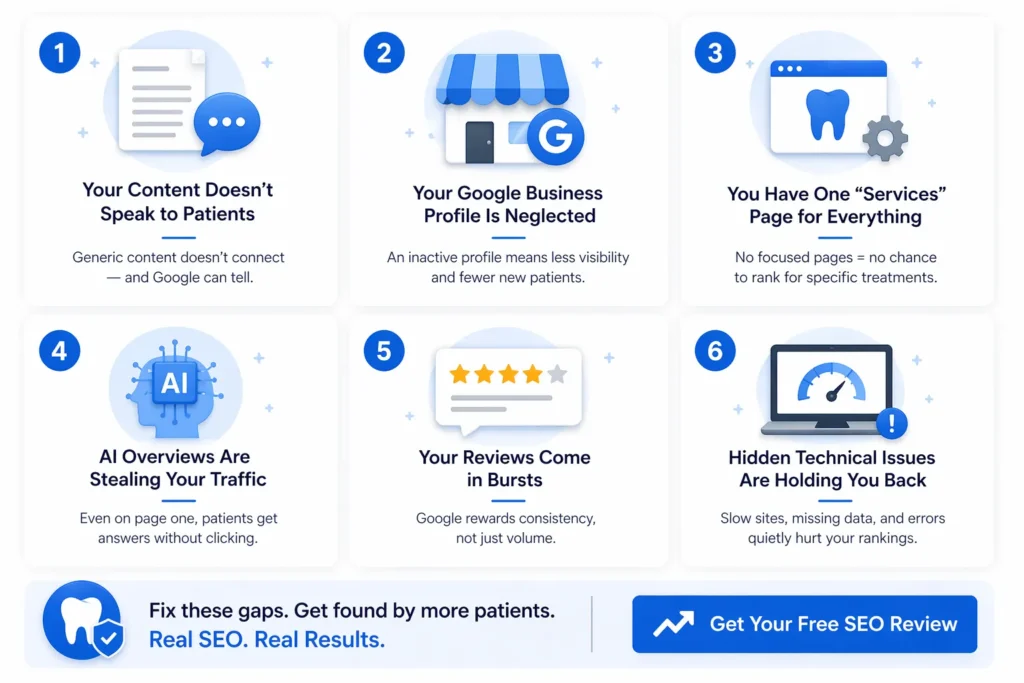
1. Your Website Content Talks About Dentistry — But It Doesn’t Sound Like a Dentist Wrote It
This is the most common problem we see. And it’s doing more damage than most practice owners realise.
Generic content — the kind churned out by a marketing agency that also handles plumbers, estate agents, and car dealerships — doesn’t cut it in 2026. Google has become very good at recognising the difference between content that was written to genuinely help a patient, and content that was written to fill space and tick an SEO box.
Think about how your actual patients search. They’re not typing “professional dental services in [city].” They’re typing things like “how painful is a root canal really,” “is Invisalign worth it for adults,” “emergency dentist open on a Sunday near me,” “why does my tooth hurt when I drink something cold.” Those are real searches, happening thousands of times every day in every city.
If your website doesn’t speak directly to those questions — in plain, honest, human language — Google quietly passes you over for a practice whose website actually does.
The fix isn’t to publish more blog posts about the importance of flossing. It’s to build content that genuinely answers what your patients are already asking, written in a way that makes a nervous patient feel like they’re being spoken to by someone who understands them.
Our SEO Services at Digital OmniTech are built around exactly this — real, patient-focused content strategies that Google trusts and actual people want to read.
2. Your Google Business Profile Is Either Half-Finished or Just Sitting There Untouched
Here’s something that surprises almost every dentist we talk to. For most dental practices, the Google Business Profile — that panel that shows up in Google Maps and on the right side of search results — drives more new patient enquiries than the actual website.
Yet most practices either set it up a couple of years ago and haven’t touched it since, or half-filled it out at some point and moved on.
In 2026 your Google Business Profile needs to be treated like a living, active part of your online presence — not a one-time task you tick off and forget. Google pays close attention to things like how recently you posted an update, how many new reviews are coming in and how regularly, whether you’ve uploaded fresh photos lately, and whether the services you’ve listed actually match what people in your area are searching for.
The difference between a properly managed profile and a neglected one isn’t small. Practices with fully optimised, actively maintained profiles get dramatically more visibility in local search than those who set it and forget it. And that visibility gap translates directly into how many times your phone rings each week.
A few things most dental practices miss on their GBP:
- Not listing individual services separately (root canal, teeth whitening, implants, Invisalign — each one should be there)
- Not responding to reviews, especially negative ones
- Not uploading new photos regularly — this signals to Google that the business is active and engaged
- Only having “Dentist” as the primary category without adding relevant secondary specialties
If you’d like help getting your local visibility properly sorted, our Local SEO Services cover Google Business Profile optimisation as a core part of every strategy we build.
3. You Have One “Services” Page Instead of Individual Pages for Each Treatment
This one quietly kills rankings for a huge number of dental websites. And most practices have no idea it’s happening.
Here’s the problem. If your website has a single page called “Our Services” that lists dental implants, teeth whitening, Invisalign, veneers, emergency dentistry, and children’s dentistry all in one place — Google genuinely doesn’t know which treatment to rank you for. It sees one page trying to be about everything, and it ranks it for nothing in particular.
Every meaningful service your practice offers needs its own dedicated page. A page about dental implants should be entirely about dental implants — what the procedure involves, who it’s right for, what the process looks like from consultation to completion, what patients typically worry about, how long it takes, what recovery is like, and why your practice is the right choice for it.
When someone types “dental implants in [your city]” into Google, it needs a clear, detailed, well-structured page to send them to. A generic services page doesn’t compete for that search — not in 2026.
This is one of the very first things we fix when a dental practice comes to us. It consistently produces some of the most visible ranking improvements, often within just a few months of getting the pages properly built.
4. The AI Search Problem That’s Eating Your Traffic — Even If You’re on Page One
This is the newest issue, and it’s one that most dentists haven’t heard about yet — even though it’s already affecting them.
Google now generates AI-powered answer summaries at the very top of search results. These are called AI Overviews, and for dental searches specifically, they appear on the majority of results pages. What they do is answer the patient’s question directly — right there on the results page — without the patient ever needing to click through to any website.
What that means in practical terms: even if you rank on page one, a significant portion of people searching are getting their answer from Google’s AI summary and leaving without ever visiting your site.
But here’s the part that most agencies aren’t telling their clients — and this is actually a real opportunity for practices that move quickly. If your website is structured correctly, with clear direct answers written in proper natural language, Google’s AI can actually pull content from your pages when building those summaries. Your practice name, your answers, your expertise — showing up in front of patients before they even decide where to click.
Most dental websites aren’t built to take advantage of this at all. The ones that are will have a meaningful edge over the next few years that their competitors won’t be able to close quickly.
If you want to understand how this affects your practice specifically, have a look at our blog post on How to Rank on Google Fast in 2026 — it covers some of the structural changes that are making the biggest difference right now.
5. Your Reviews Come In Bursts — And Google Has Noticed
This is something almost nobody talks about but it matters a lot.
Most dental practices follow the same pattern with reviews. Someone on the team gets enthusiastic, they ask patients for a week or two, thirty reviews come in, and then it completely drops off for the next four months. Then the cycle repeats.
Google’s local ranking algorithm has shifted significantly in this area. It now rewards consistency far more than volume. A practice getting three to five genuine reviews every week will outperform a practice that collected fifty reviews in a single month and then went quiet — even if the second practice has more total reviews on its profile.
Reviews are also doing something much bigger than just affecting rankings. When a patient is choosing between your practice and the one two streets over, the first thing they actually do is read what people say about you. Not just the star rating — the real comments. How was the front desk? Did you have to wait? Was the dentist gentle? Did they explain things clearly? Were you made to feel comfortable?
A thoughtful response to a negative review — one that shows you actually care and took the feedback seriously — is more reassuring to a prospective patient than a page of five-star reviews with no responses. It shows that a real person is paying attention.
Building a simple, consistent system for asking every happy patient to leave a review — and responding to every single one — isn’t optional infrastructure for a dental practice in 2026. It’s as fundamental as having a phone number on your website.
6. Your Website Has Technical Problems You Can’t See From the Front End
This one happens silently. Your website looks completely fine when you open it on your office computer. But Google crawls it differently, across multiple devices and connection speeds, and it finds things that are invisible to you.
A website that loads slowly on mobile. Images that haven’t been compressed properly. Pages that Google’s crawler can’t read correctly because of how the site was originally coded. Broken internal links that were never cleaned up after a redesign. Meta descriptions that are either missing or duplicated across multiple pages. No structured data markup telling Google clearly that this is a dental practice, what your opening hours are, where you’re located, what services you offer.
These technical issues don’t make your site disappear from Google overnight. They suppress your rankings slowly and persistently — like a slow puncture in a tyre. You don’t notice it until you’ve already lost significant ground to competitors whose sites are technically cleaner.
This is exactly why a proper technical SEO audit — one that actually looks under the bonnet of your website and identifies these issues — is something every dental practice should have done. Most never have.
Our Technical SEO Services at Digital OmniTech are designed to find and fix exactly these kinds of issues. The kind that are quietly costing you rankings every single month without making any obvious noise.
What Good Dental SEO Actually Looks Like in 2026
Now that we’ve covered what’s going wrong, let’s talk about what getting it right actually looks like — because it’s quite different from what a lot of agencies are selling.
Good dental SEO in 2026 isn’t a collection of tricks. It’s not two blog posts a month and a monthly ranking report with lots of green arrows. It’s about building real, genuine online authority — the kind that Google respects because real patients respect it too.
Practically speaking, here’s what that looks like for a dental practice:
A website that earns trust before the patient ever picks up the phone. Clear, well-written individual service pages. Real photos of your team and your actual practice. Dentist profiles that show the human being behind the qualifications. Content that answers the questions patients are genuinely asking, in language they understand without needing a dental degree.
A local presence that’s consistent everywhere Google looks. Your practice name, address, and phone number need to be identical across every directory, every online listing, every platform. A discrepancy as small as “Street” versus “St” creates confusion that quietly hurts your local rankings.
Reviews that come in regularly, not in occasional bursts. A simple system, embedded into your practice workflow, for asking satisfied patients to share their experience — and a habit of responding to every review that comes in.
A Google Business Profile that’s treated like a window into your practice. Updated with new posts. Fresh photos uploaded regularly. Services listed completely and accurately. Questions answered. Activity that signals to Google that this is a live, engaged, trustworthy business.
Content that genuinely helps people — not content that exists just to have content. This is the biggest gap we see across dental websites. Real answers to real patient questions, written with actual expertise, structured so that both Google and AI search tools can understand and recommend it.
Understanding these fundamentals also ties directly into broader search visibility. Our blog post on Top SEO Mistakes to Avoid That Hurt Your Website Rankings covers several of these patterns in more depth — worth reading if you want to understand what’s working and what’s hurting practices right now.
How Long Does It Actually Take? The Honest Answer
Here’s what most agencies won’t tell you upfront.
If your dental SEO is being done properly, you should start seeing early signs of movement within the first three months — better visibility in the local map pack, more clicks and calls coming through your Google Business Profile, more people finding your practice from search.
Meaningful, consistent ranking improvements for competitive service terms — implants, Invisalign, cosmetic dentistry — typically take six to nine months of consistent work. In a highly competitive market, a major city with dozens of dental practices all doing SEO, it can take twelve months or more to build the kind of domain authority that puts you at the top.
Anyone who quotes you first-page rankings in thirty days is either going to cut corners, or they’re going to do something that eventually triggers a Google penalty and sets you back further than where you started.
Think about it this way. SEO is less like switching on a light and more like building a reputation in a new community. You show up consistently. You earn trust over time. You give people reasons to recommend you. And when it compounds — when new patients start calling every week because they found you on Google without a penny spent on ads — it becomes one of the most valuable things your practice ever invested in.
The Uncomfortable Truth About Why Some Practices Stay Invisible for Years
Sometimes the issue isn’t the strategy at all. It’s who’s executing it.
We’ve spoken to dentists who’ve been paying an agency for eighteen months, receiving polished monthly reports full of green ticks and encouraging-sounding metrics, while their phone rings no more than it did before they started.
The reports look great. The results aren’t there. The new patients definitely aren’t there.
This happens because a lot of agencies treat dental clients exactly like every other client. They run the same general playbook — some blog posts, keyword tracking, basic link building — without understanding that dental SEO operates in a different category. Google classifies dental websites under healthcare, which means it holds them to a significantly higher standard. The expertise signals need to be stronger. The content has to be more accurate and more genuinely useful. The trust signals matter more. The local authority needs to be more credible.
Generic agency work applied to dental SEO doesn’t just fail to move the needle. It wastes months and real money while your competitors — the ones working with people who actually understand healthcare SEO — pull further and further ahead.
If that situation sounds familiar — if you’ve been paying for SEO and feeling like nothing is actually happening — the right first move is a proper audit. Not an automated scan that generates a colour-coded report in twenty seconds. A genuine, thorough look at your website, your local presence, your content quality, your competition, and what specifically needs to change.
You can start that conversation with us through the Digital OmniTech Contact Page. We’ll give you an honest picture of where things actually stand — without the jargon, without the pressure.
Be Honest With Yourself — Run Through This Quick Check
Answer these honestly:
- When you search “dentist [your city]” right now, do you appear in the top three map results?
- Does each of your main services — implants, whitening, Invisalign, emergency care — have its own dedicated, well-written page?
- Have you received at least three new Google reviews in the past month?
- Does your website load fully on a mobile phone in under three seconds?
- Has your Google Business Profile been updated with a new post or photo in the last two weeks?
- Does your website actually answer the specific questions your patients ask you in the chair?
If you answered no to three or more of those, your dental SEO has real, fixable gaps that are costing you new patients right now. Not in theory — in actual, countable patients per month who found your competitor instead of you.
What to Do Next
None of this is as complicated as it sounds once you understand what actually matters. The problems most dental practices have are fixable. The gap between where you’re showing up today and where you should be showing up can be closed — it just needs the right approach, done consistently, by people who understand both SEO and the specific way healthcare practices build trust online.
At Digital Omnitech, we work with local businesses and service practices to build the kind of online presence that brings in new patients every week — through real SEO work, not reports that look good but don’t produce anything.
If you’d like to understand what’s holding your practice back, start with our SEO Services page to see what a properly built strategy looks like. Or if you’d rather just talk through your situation first — no pitch, no pressure — reach out to us directly through our Contact page.
Your practice deserves to be found by the patients who are already looking for you. That’s the whole point.